

Standardize. Streamline. Scale.
Blaze: A Smarter Way to Share & Access Diligence Data
Asset managers maintain live Blaze profiles for free, standardized data updated directly by the source, distributed to every authorized allocator on the network. Update once. No re-requesting. No version confusion.

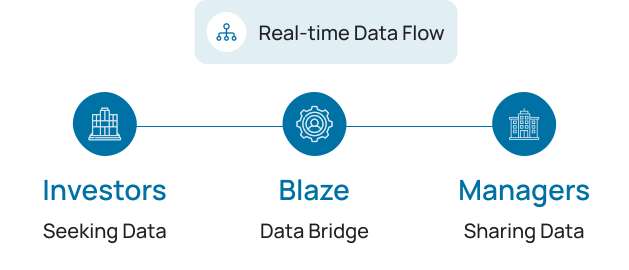
Due diligence is getting more complex and volume is only growing. According to DV research, 80% of all due diligence requests received have bespoke elements, making standardization not a nice-to-have, but a necessity.
Investors need timely insights and greater transparency, without placing greater burden on asset managers. Asset Managers are overwhelmed. Without consistency in data requests, the teams face:
Answering similar questions from dozens of investors in slightly different formats
Time pulled away from focused on value added investor reporting and fundraising to handle manual overload
Drowning in increased volume and complexity of DDQs and RFPs
Manual processes that are error-prone, delayed, and impossible to scale efficiently.
The Investor and Asset Managers Pain Points
Global Asset Manager
We receive multiple surveys with slight differences… it’s very onerous to complete slightly different responses. If DiligenceVault could align its users to collect the same exact survey, that would be very helpful.
Private Equity GP
How Blaze Works
Simple steps to transform your diligence process
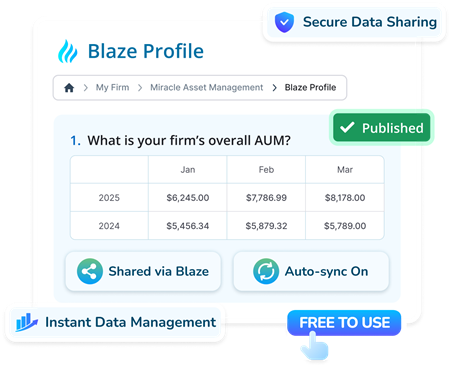
Opt-In
Managers choose to participate in the Blaze network
Seamless Update
Easily update Blaze data bridge once via UI or Excel sync process.
Publish
Standardized data becomes available to authorized investors
Investors Access
Real-time access to up-to-date diligence information
What’s Included in Blaze Data Bridge
Essential features to get you started with streamlined diligence
Standard Questions
Core financial metrics and performance data that investors need most
Upload Methods
Excel import and intuitive UI for easy data entry
Entity Levels Supported
Firm, Fund, Strategy, Vehicle - complete organizational coverage
Advanced Features
Auto-Sync, Revision History, Complete Audit Trail
Frequently Asked Questions
Does Blaze work across all asset classes?
Yes, Blaze supports all asset classes across Private Equity, Real Estate, Hedge Funds, long only strategies and funds. The platform is designed to standardize diligence data across different asset classes, making it versatile for various investment strategies and fund types.
Is Blaze free for DiligenceVault clients?
Yes, Blaze is available at no additional cost for DiligenceVault subscribers for their existing manager relationships. This is part of our commitment to enhancing the diligence process for our existing client base without adding financial burden.
How does real-time data sync work?
As soon as managers update and refresh Blaze profiles, your data will update.
No need to send questionnaires.
What does 'standardized data formats' mean?
Blaze ensures consistent formatting across all responses, making it easier for investors to compare and analyze information. This eliminates the confusion that comes from receiving the same data in different formats from different managers.
Does Blaze provide audit trail and version control?
Yes, Blaze maintains a complete history of all data changes, including who made changes and when. This provides full transparency and accountability for all data updates, which is crucial for compliance and trust.
Can I add custom questions beyond the standard ones?
In Phase 1, Blaze focuses on standardizing the most common diligence questions to maximize efficiency and consistency. DiligenceVault will be adding additional data tiers in collaboration with clients.
How secure is my data in Blaze?
Blaze is built with enterprise-grade security measures. You maintain full control over who sees your data and when. All data transmission is encrypted, and access is managed through robust authentication and authorization controls.
How does Blaze integrate with my existing data on DiligenceVault?
Blaze is designed to work seamlessly with your current content library on DiligenceVault. The primary goal of Blaze Data Bridge is to reduce the need for manual data entry and ensuring consistency across our platform.
Explore other use cases
Investment Compliance and Subadvisor Oversight
Automate attestations, reviews, and risk monitoring to maintain proactive compliance and transparent stakeholder reporting.
Manager Research
Digitize and centralize manager sourcing, evaluation, and monitoring to accelerate investment decisions and streamline IC memo creation.
ManCo Diligence
Build a repeatable, scalable oversight framework for assessing and monitoring delegates and service providers.
Operational Due Diligence
Digitally transform due diligence with automated DDQs, document review, risk analytics, and regulatory data integration for scalable oversight.
Record Keeper Diligence
Streamline recordkeeper oversight with structured data collection, benchmarking, and ongoing monitoring workflows.
Responsible Investing
Collect and track ESG data across your manager universe with standardized frameworks.
AI-Powered RFP/DDQ and Investor Reporting Automation
Auto-draft responses to RFPs and DDQs from your approved content library using DV Assist.
Investor Letters and Database Management
Streamline periodic investor reporting with automated data pulls and templated outputs.
Blaze Data Bridge
Connect and sync data across systems with seamless integrations built for asset management workflows.
Form ADV Filings
Access and analyze Form ADV filings to support manager research and regulatory compliance.
Service Provider Diligence
Build a repeatable, scalable oversight framework for tracking service provider relationships and tri-party confirmations.
Blaze ahead with DiligenceVault
Join the future of diligence data sharing. Get started today.
