

AI in the RFP Process: From Faster Drafting to Governed Response Capacity
Asset managers using AI autofill are seeing 70%+ efficiency gains on DDQ and RFP response time. The discussion in Boston covered where AI is working, where legal and compliance teams are drawing the line, and what the firms getting the best results are doing differently.
The central finding from this session was not that AI is transforming the RFP and DDQ process. It is that AI is exposing where the process is already weak. Drafting has gotten easier. Review has gotten harder. And the real constraint is not the technology, it is sign-off. The question is not whether AI can generate a response. It is whether anyone is willing to put their name on it.
AI does not create a knowledge library. It reveals whether you have one.
How Asset Managers Are Using AI in RFP and DDQ Workflows
Firms are using AI to autofill recurring DDQs, surface approved prior responses, flag stale or inconsistent language, and support translation workflows. The strongest results come when AI is paired with a structured content library, source citations on every suggested response, a compliance review layer, and human approval before submission. Two distinct AI and automation workflows are needed: one designed for recurring and standard requests where approved language already exists, and a separate workflow for bespoke consultant RFPs and complex mandates where content discovery, structuring, and drafting assistance serve a different purpose.
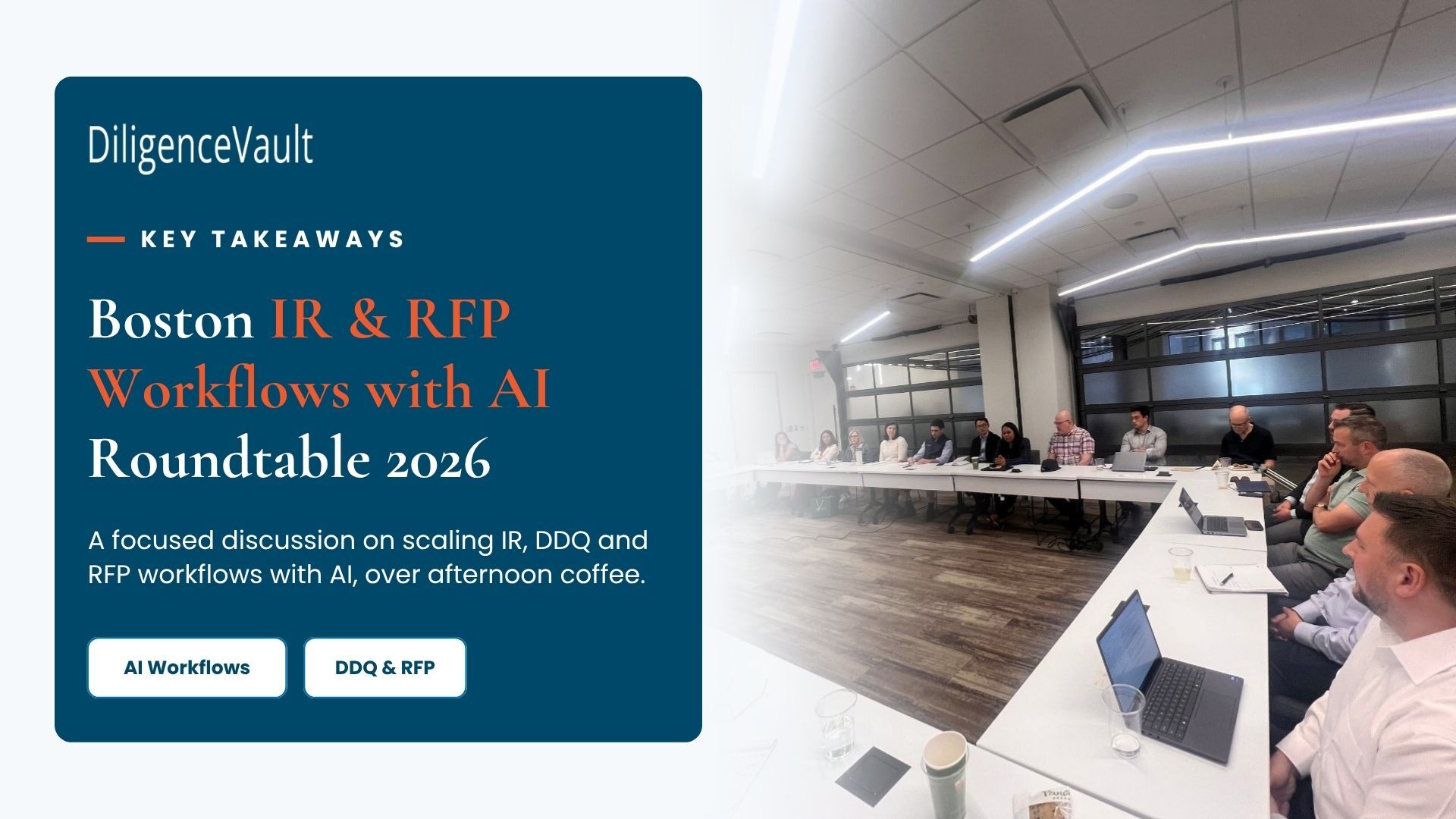
We were grateful to host IR, RFP, marketing, and compliance professionals from asset managers of all sizes for a frank discussion on where AI is actually being used, where it is falling short, and what the industry needs to figure out before the ROI case becomes clear.
All insights are attributed to the group. No individual firm or participant is identified.
Key Takeaways
- The volume is real and growing. Firms in the room are managing anywhere from 50 to over 4,000 DDQ and RFP responses annually, across up to 30 portals. The fragmentation problem is getting worse, not better.
- AI is useful for first drafts, not final answers. The consistent expectation is a first pass that pulls verbatim language where available. Beyond that, AI output requires careful review. Stale data, industry slang, and over-confident tone are recurring issues.
- Legal and compliance teams are not comfortable with AI-generated responses. The constraint is the approval chain, not the technology. The path to sign-off is AI that flags low-confidence suggestions and surfaces its reasoning, so reviewers know where to focus rather than verifying everything.
- Compartmentalizing is the governance model that is working. Scanning for specific language, flagging changes to compliance, and pointing prompts to source documents are the practices that have gained traction.
- Agent building and custom chats are where the more sophisticated firms are experimenting. Multi-affiliate models in particular are finding value in custom voice and tone configurations.
- Portals are a major pain point. Most client-specific portals are the hardest to use. Export-and-reimport workflows are common workarounds. The overhead of managing multiple portal formats may be growing faster than AI can offset it.
- DiligenceVault clients are seeing 70%+ efficiency gains. AI autofill for quarterly recurring requests and net new DDQs is delivering material time savings. Quality of autofill and quality of review are what determine whether those gains hold.
- DDQ complexity is increasing. More detailed questions, new subject areas including AI governance, and more portals to manage. The volume problem is harder than it was five years ago, which makes the efficiency case for AI autofill stronger.
- ROI is clearest for standard and recurring requests. Bespoke, complex, or pension-mandate-level RFPs still require significant human judgment in drafting, but AI materially helps with content discovery and structuring even there.
The Volume Reality: How Much Are Managers Actually Responding To?
Before discussing AI, the group grounded the conversation in the actual scale of the problem. Participants were asked how many DDQs, RFPs, and RFIs their teams respond to annually. The range was wide, but the common thread was that the volume is substantial, often growing, and concentrated in a way that makes the high end of the range disproportionately burdensome.
The dense, long-form responses are where the time cost concentrates. One firm noted that 30% of their total volume is full RFPs. Another distinguished between 50 to 100 recurring business renewals per quarter and 50 to 100 new RFPs, each requiring materially different effort. A third manages roughly 250 existing client requests per quarter alongside a traditional long-form pipeline.
One finding that illustrates the standardization challenge from both directions: one firm reported that 80% of their clients use the firm's standard DDQ, which significantly reduces customization burden. Another was the mirror image: only 20% of their clients use the standard DDQ. Both experiences were represented in the same room.
The firms managing 25 dense responses and the firms managing 4,000 lighter ones have different problems. What they share is that neither has fully solved them.
AI in the Drafting Workflow: Useful First Pass, Unreliable Finisher
There is broad adoption of AI tools in the drafting stage of RFP and DDQ responses. Copilot is the most commonly mentioned tool for document discovery: finding the right prior response, locating the relevant section of a fund document, surfacing precedent language. That use case is working reasonably well.
The expectation across the room was consistent: AI should produce a first pass that pulls verbatim approved language where it exists, flags gaps, and gives a reviewer something to work with rather than a blank page. That framing reflects where the technology is actually useful and where it falls short.
Where it falls short was discussed in specific terms:
AI will confidently pull an AUM figure from 2024 in a 2026 response if that is what the source document contains. It does not flag the vintage of the data it is citing. Reviewers have to catch this.
Firm-specific terminology, strategy names, and asset class conventions trip AI tools. The output can be technically correct but wrong in register, or confidently wrong on a term of art.
AI tends to generate responses that are more enthusiastic and more general than the precise, measured language institutional responses require. Prompt engineering helps, but requires expertise to do well.
Structured fields and tables are a consistent failure point in generic AI autofill tools. Formatting breaks, data lands in wrong cells, and the review burden for tabular responses often exceeds the drafting time saved. DiligenceVault's AI autofill is built to handle table structures accurately, one of the more technically demanding requirements in DDQ response workflows.
One firm described using Copilot specifically to make language more generic, stripping firm-specific voice before using it as a base for a new response. Another mentioned AI's usefulness for translation workflows, where generating an initial draft in a target language before human review reduces turnaround time materially.
The framing that resonated: AI as a consultant or quality control layer, poking holes in a draft rather than generating the answer. That is a different use case than most tools are marketed for, but it is where practitioners are finding reliable value.
The Compliance Tension: GenAI Responses and Legal Sign-Off
The question was put directly: how comfortable are your legal and compliance teams with AI generating responses in your content library?
The answer was nearly unanimous: not comfortable.
There have been a lot of misses with GenAI in this context. Responses that sound right but cite the wrong figure. Language that is close but not approved. Tone that passes a casual read and fails a compliance one. The accumulation of those misses is why the governing constraint on AI adoption in RFP workflows is not the technology. It is the approval chain. The question is not whether the tool can generate a response. It is whether anyone is willing to put their name on it.
CCOs and legal teams are drawing a clear line between AI-assisted drafting and AI-generated responses, and most are not yet willing to cross it. The path forward is not to argue them across that line. It is to design workflows that make sign-off achievable.
The path to sign-off is not better AI. It is a workflow where every suggested response points to its source, every deviation is flagged before it goes out, and compliance has a clear audit trail of what changed and why.
That is also where the design of the autofill tool itself matters. Generic AI presents output with uniform confidence whether it is drawing on a strong source match or making an inference with little to support it. DiligenceVault's AI autofill flags responses where confidence is limited and surfaces the reasoning behind each suggestion, so reviewers know immediately which answers to accept, which to scrutinize, and which to rewrite. The review process becomes targeted rather than comprehensive. That is what makes sign-off achievable at scale rather than theoretically possible.
The practice that has gained the most traction as a middle path is compartmentalizing: using AI to scan existing approved responses for specific language, flag deviations from approved content, and alert compliance when a change has been made. The AI is not generating the answer. It is monitoring the integrity of the approved answer library and surfacing changes that need review.
Prompts That Point to Their Sources
Several firms have adopted a practice of configuring AI tools to cite the source document for every piece of language it surfaces. If the output cannot point to where it got the information from, it does not go into a draft. This creates a simple audit trail and gives compliance a way to verify that generated language has a documentary basis.
At the Boston session, a discussion of the SEC marketing rule as a specific compliance flagging example drew significant attention. The application: using AI to scan outgoing responses for language that may trigger marketing rule review, flagging it to compliance before it goes out. That is a use case where AI reduces compliance risk rather than creating it, and it represents a meaningful shift in how the tools are being positioned internally.
For firms still building their AI governance frameworks, this framing, AI as a compliance monitoring layer rather than a response generation layer, may offer a more straightforward path to legal sign-off than a full generative AI deployment.
Agent Building and Custom Configurations: Where Sophisticated Firms Are Experimenting
Beyond the standard AI tool deployments, a subset of firms are moving into more structured experimentation: building agents, creating custom project configurations, and developing firm-specific chat environments with curated document sets.
One firm described loading their full document library as a source and using that as the basis for an agent that could help build a sustainability report. The output was not publication-ready, but it substantially reduced the time to first draft by surfacing relevant source material and generating a structured outline from the firm's own language.
The multi-affiliate model is the most complex AI configuration challenge in this space. Different affiliates have different investment voices, different client relationships, and different regulatory contexts. Some firms are building custom chat environments for each affiliate, each with a curated document set and configured to generate responses in the specific tone and register of that entity. That level of configuration requires meaningful upfront investment, but participants running multi-affiliate businesses reported it as one of the more promising AI applications they had encountered.
- Custom project configurations with affiliate-specific document sets and tone guidelines
- Agents built on product data, with firms finding the piecemeal approach challenging when data sources are inconsistent
- Monthly internal communications highlighting top AI users and new use case suggestions, as one firm's adoption strategy
- Internal AI education programs, bootcamps, and skills training cited as prerequisites to meaningful adoption
One consistent theme across the agent-building discussion: source quality is the binding constraint. The sophistication of the agent matters less than the quality and currency of the documents it draws on. An agent built on an outdated or inconsistently maintained content library will produce outdated, inconsistent output regardless of how well it is configured.
Portal Proliferation: The Fragmentation Problem Is Getting Worse
The portal landscape came up repeatedly and with consistent frustration. One firm is managing 25 to 30 active portals. Across the room, the picture was of a rapidly expanding set of client-specific requirements that show no sign of consolidating.
Not all portals are built the same, and the differences compound across a large allocator base. Many client-specific portals are white-labeled technology: the same underlying platform deployed differently by each allocator, each requiring a separate login, each with its own field structure and submission format. A manager responding to 30 allocators may be managing 30 separate portal instances with no ability to carry approved content from one to the next. Every response starts over. Approved language that exists in one portal cannot be reused in another without manual copying and reformatting. Some portals do not allow team collaboration within the portal itself, forcing parallel offline drafting. Some do not allow exports. Some have surprise nesting, questions buried inside questions in ways that are only discoverable mid-completion.
| Portal Type | Status | Common Issue |
|---|---|---|
| DiligenceVault | Most Liked | Named as the most used and most liked platform across participants, collaborative, exportable, and AI-autofill enabled |
| Qualtrics / PSN | Workable | Familiar enough that teams have developed workflows around them |
| Client-specific portals | Most Difficult | No standardization across instances; multiple logins, no collaboration, no export, hidden nesting |
A common workaround: some portals support an export function that allows responses to be drafted externally and then reimported. Teams are using this to centralize their drafting workflow before pushing back into the portal. It is a manual solution to a structural problem, and it creates its own version control and formatting risks.
The portal problem and the AI problem are related but distinct. AI tools that work well in a centralized content environment still require manual reformatting when the same content needs to fit 25 different portal schemas. Portal fragmentation is not a problem AI autofill solves, it is overhead that runs alongside it, and it is growing.
The question is not just which portals exist. It is how much of a team's capacity is being consumed by login management, format translation, and workarounds, rather than substantive response work.
This matters to allocators directly. A manager whose IR and RFP team is absorbing significant overhead in portal management and manual reformatting has less capacity for the quality, currency, and consistency of the responses themselves. Stale data, incomplete answers, and inconsistent language across portals are often symptoms of operational strain, not negligence. Allocators who understand the portal landscape are better positioned to interpret what they receive, and to ask the right questions about how a manager's response workflow is actually governed.
ROI: Early Results Are Promising, but the Review Layer Is the Differentiator
The ROI question was asked directly. Across the room, most firms are still early in measuring net time savings with confidence. But the direction is clear, and for teams using purpose-built AI autofill tools, the results are already material.
DiligenceVault clients using AI autofill for DDQ and RFP responses are seeing efficiency gains of 70% or more on response time. The impact is most pronounced in two workflows: quarterly recurring requests, where AI autofill draws on prior approved responses to pre-populate standard fields at the start of each cycle, and net new requests, where AI surfaces the most relevant prior language from a structured content library rather than starting from a blank document.
The efficiency gain is real. What separates good AI autofill from fast-but-unreliable output is the quality of the review layer that follows it.
That distinction matters. Speed at the drafting stage is only valuable if the output is accurate enough to review efficiently. AI that generates a confident but stale or tonally off response creates more review burden than it saves. The quality of AI autofill, how well it handles data currency, firm-specific terminology, table structures, and nuanced question types, and the quality of the review workflow built around it are what determine whether the 70% efficiency gain holds in practice.
One participant offered a counterexample worth naming directly. Quarterly recurring requests used to be handled by pulling the prior approved version and editing what had changed - a process that took roughly ten minutes. With AI regenerating the full response each cycle from the source library, the output requires a full review pass rather than a targeted edit. What was a ten-minute update is now materially longer.
That experience points to a specific design principle: AI autofill should be additive to prior approved responses, not a replacement for them. The right workflow for recurring requests is AI-assisted updating, pre-populating unchanged fields from the prior version, flagging only what has changed for review, and surfacing any data that has gone stale since the last cycle. Full regeneration from scratch each quarter trades a known, efficient workflow for an AI-assisted one that reintroduces review burden the prior process had already eliminated. The efficiency case for recurring requests depends entirely on whether the tool is designed to work with versioned history, not around it.
The use case context matters. Recurring and standard requests need an autofill-first workflow. Bespoke requests need a content-discovery-and-drafting workflow. These are different enough in process, review depth, and tooling that treating them the same produces the wrong result for one of them.
- Quarterly recurring updates: AI autofill pre-populates from prior approved responses, reducing cycle time substantially
- Net new standard requests: AI surfaces relevant prior language and structures a first draft for reviewer sign-off
- Bespoke and complex RFPs: a separate AI workflow supports content discovery, structuring, and drafting assistance, different tooling and review process than recurring requests
- Token limitations remain a real constraint for very dense, long-form responses requiring full document context
One observation that surfaced on the allocator side of the same event: allocators are beginning to ask managers whether they use AI in preparing DDQ responses, and some specifically ask whether AI is used within DiligenceVault. That question is worth being prepared for. Having a clear, accurate description of how AI is used in your response workflow, what it assists with, and what human review process sits above it, reflects well on a firm's operational maturity rather than raising concerns.
Promoting AI best practices internally is an investment that pays forward. One firm described a monthly email to their team highlighting top AI users and new suggested use cases, a lightweight adoption strategy that builds capability without requiring formal training infrastructure. The firms getting the most out of AI tools are the ones treating prompt quality, source discipline, and review workflow as skills worth developing, not as givens.
Five Steps to Scale DDQ and RFP Workflows with AI
This is not just an RFP team productivity issue. It is a distribution capacity issue. As diligence volume rises, portals multiply, and allocators ask more detailed questions about operations, AI governance, fees, and cybersecurity, the firms that scale are the ones that turn response workflows into governed data workflows. What follows reflects the practices that came up consistently across the discussion as what the highest-performing teams are doing.
Design two distinct workflows: one for recurring requests, one for bespoke
Recurring DDQs, quarterly updates, standard RFIs, and existing-client renewals require an autofill-first workflow: AI pre-populates from approved prior responses, flags what has changed, and routes for targeted review. Bespoke consultant RFPs and complex mandates require a different workflow: AI assists with content discovery, surfacing relevant prior language and structuring a starting point, but the drafting process is more collaborative and the review more intensive. Trying to run both through the same workflow produces the wrong result for at least one of them.
Treat the content library as governed infrastructure, not a shared folder
AI has elevated the need for a clean, curated, and expansive knowledge library. For firms managing high volumes of DDQ and RFP requests, this is the foundation that determines how much leverage autofill can actually deliver. Every approved answer should have an owner, an approval status, a source document, and a review date. Stale AUM figures, superseded compliance disclosures, and outdated ESG language should be detectable before they enter a response. The quality ceiling on AI output is set entirely by the quality of the content library beneath it.
One failure mode to avoid: loading every available document into the source set and expecting AI to extract accurate answers from the volume. A large, undifferentiated library produces inconsistent, hard-to-verify output. Curation is as important as coverage. The goal is a library where every source document is current, approved, and purposefully included, not a comprehensive archive that AI has to navigate without guardrails.
Build a prompt library as the blueprint for organizational consistency
Prompt quality is a skill, and like any skill it produces inconsistent results when left to individual interpretation. Firms that are getting the most consistent AI output have moved beyond ad hoc prompting to a shared prompt library: a curated set of tested, approved prompts for recurring use cases, structured to point to source documents and return output in the formats compliance has reviewed. A prompt library is the organizational blueprint that ensures AI behaves the same way whether it is being used by a senior RFP manager or a new team member on their first quarter cycle. It also requires every AI-suggested answer to point to the approved source document it drew on. No source, no submission.
Build a review layer that is risk-based, not uniform
Not every answer needs the same level of scrutiny. A recurring operational answer pulled verbatim from an approved library is different from a new claim about performance, AI governance, fees, or regulatory policy. Route responses based on risk. AI should identify what has changed, what is stale, and what may need compliance or SME escalation. Speed without that routing is speed without control.
Measure capacity gained, not just drafting time saved
The executive story is not "AI saves time." It is: AI helps IR and Distribution teams absorb rising diligence volume, respond with more consistency, and preserve senior capacity for higher-value client and prospect engagement. The metrics that tell that story include time to first draft, review time by request type, and percentage of answers sourced from approved content.
The Next RFP Workflow Will Be Governed, Not Just Faster
The Boston discussion points to a clear conclusion: the firms that benefit most from AI will not be the ones that generate the most text. They will be the ones that can govern, source, review, reuse, and update approved content across every DDQ, RFP, and portal format. That is the shift the market is making: from response drafting to response governance. And that is the workflow DiligenceVault is built around.
The argument follows directly from what practitioners described in this session:
The problem is not drafting speed. Generic AI tools can generate a first draft. The bottleneck is what happens next: whether the output is source-backed, whether compliance can sign off, whether the reviewer can trust what the tool surfaced, and whether the same process works across 30 different portal formats.
The problem is governed response capacity. As DDQ complexity increases and portal fragmentation grows, the question is not whether a team can draft faster. It is whether they can scale volume without accumulating disclosure risk, stale content, and inconsistent responses across their allocator base.
Generic AI worsens review risk when source control is weak. An undifferentiated document archive feeding an AI tool produces confident but unverifiable output, and generic AI presents every suggestion with the same confidence whether it is drawing on a strong source match or filling a gap with an inference. The review burden that follows can erase the drafting gain entirely. DiligenceVault's AI autofill is designed differently: it flags responses where confidence is limited and surfaces the reasoning behind each suggestion, so reviewers spend time where it is needed rather than verifying everything from scratch.
Portal fragmentation compounds everything. White-labeled instances, no content portability, no exports, surprise nesting, the overhead of managing 30 separate portal environments means that even well-governed content cannot travel efficiently. The workflow needs a portable data layer beneath it.
What that points to is a system with four requirements: structured content, source-backed autofill, workflow-level review routing, and portable data across relationships. Across observed DiligenceVault client workflows, teams meeting those requirements are reporting response-time reductions of 70% or more in their highest-fit use cases: recurring DDQs, quarterly updates, and standard requests where approved language already exists.
That is where DiligenceVault fits, not as an AI feature added to a portal, but as the governed infrastructure those four requirements describe. The Blaze data layer handles portability. The AI autofill handles structured, source-backed content retrieval. The review workflow handles risk routing and compliance escalation. The result is not just faster responses. It is a response operation that gets more accurate and more reliable with each cycle.
See it in practice:
Questions Left Open
- At what point do legal and compliance teams become comfortable with AI-generated responses, and what does the governance framework that gets them there actually look like?
- If the review burden grows alongside the drafting speed gain, is the net ROI of AI in RFP workflows positive, and how would you measure it?
- As portal proliferation continues, is there a realistic path to standardization, or is managing fragmentation a permanent feature of the IR function?
- For multi-affiliate firms building custom AI configurations, what is the maintenance burden of keeping affiliate-specific document sets current, and does that overhead undermine the efficiency case?
Allocator ODD Session: AI Governance, Valuations, DDQs, and Fee Pressure
The parallel session with allocators covered the same AI governance questions from the other side of the relationship, what allocators are beginning to scrutinize in manager operations, how valuation practices are being reviewed in private credit and VC, and why the fee pressure narrative does not match the reality of how managers are actually pricing their services.
Read the allocator session takeaways