

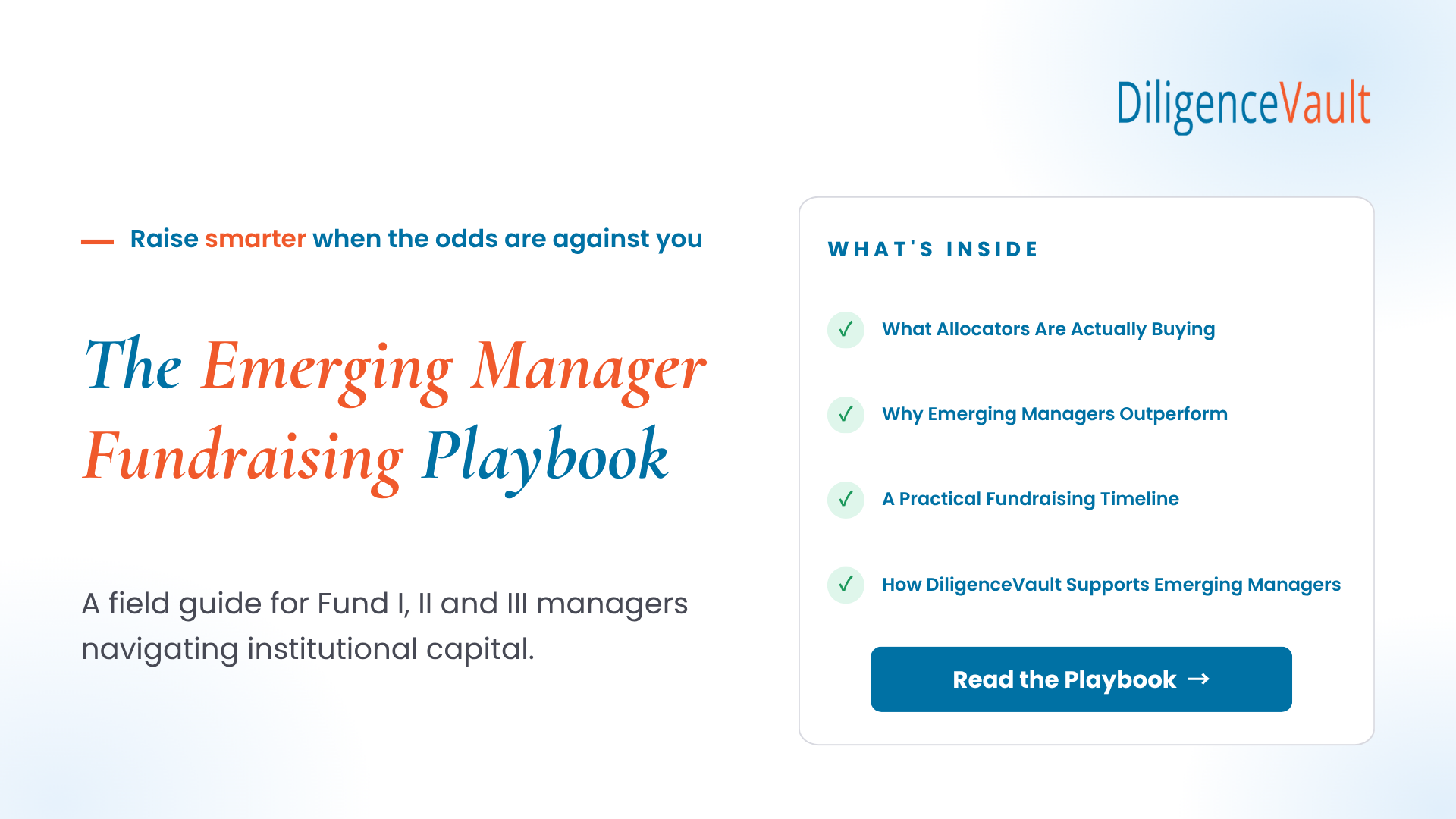
The Emerging Manager
Fundraising Playbook
How to raise smarter when the odds are against you. A field guide for Fund I, II, and III managers in private markets navigating institutional capital.
Emerging managers are not imagining it. Fundraising is harder than the headlines suggest.
There are more managers in market, more strategies competing for attention, and more pressure on allocators to justify every new relationship. But the allocator base with a real mandate to back emerging managers - not just a theoretical openness to them - has not kept pace.
At most events designed for this segment, managers outnumber allocators. Everyone is pitching. Very few people are being heard.
That does not mean emerging managers cannot break through. It means they have to stop competing on volume and start competing on precision.
What Allocators Are Actually Buying at Each Stage
Allocators are not underwriting the same thing at Fund I, II, and III. Getting this wrong is one of the most common reasons emerging managers talk past the room.
You Are Selling the Person
Conviction, edge, sourcing story, reference quality. The human is the underwrite.
You Are Selling the Firm
Team depth, re-up rate, operational infrastructure, portfolio construction discipline.
You Are Selling the Track Record
Audited performance, vintage consistency, succession depth, strategy scalability.
Fund I: The Human Underwrite
- Differentiated investment thesis - a specific, defensible view of where and why you have an edge others do not
- Sourcing edge - how you find deals, and why that is repeatable and proprietary
- Prior track record as an individual - investment performance in prior roles, even if not audited under this fund’s name
- Reference quality - former colleagues, co-investors, and prior LPs who will say the same things unprompted
- Anchor relationships - early believers whose commitment signals that those who know you best have made the bet
Fund II: Institutional Durability
- Vintage performance - Fund I data: entry multiples, realized returns, marks, exits
- Portfolio construction discipline - did Fund I look like what was promised? Mandate drift is a red flag.
- Team depth - evidence of institutional continuity beyond the founder
- Operational infrastructure - CFO, compliance, fund administration, audit scrutinized seriously for the first time
- LP re-up rate - existing LPs who do not return need a clear explanation
Fund III: Let the Data Talk
- Audited performance across vintages - DPI, TVPI, IRR by fund, with deal-level attribution
- Consistency of approach - mandate drift or concentration shifts need explanation
- Succession depth - investment committee, decision rights, organizational structure beyond the GP
- Scalability - can the thesis absorb more capital without returns compression?
Most allocator skepticism is not about the manager being wrong. It is about the manager not understanding what stage they are in - and therefore pitching the wrong thing.
The Graduation Problem
Not all Fund I capital is equal - and the difference shows at Fund II.
While many programs write a check into a debut Fund I to hit diversity or impact mandates, the true test is whether initial LPs have the structural capacity to follow on into Fund II and Fund III out of their core, unrestricted balance sheets.
The graduation problem: the very programs designed to help emerging managers can inadvertently trap them at the stage they were built to escape.
“A $50M Fund I anchored by two LPs with unrestricted balance sheets is a stronger foundation than a $150M Fund I spread across eight program-constrained allocators whose mandate ends at ‘emerging.’”
- Ask whether the LP can follow on - not just whether they can invest now. What is their structural capacity at Fund II?
- Understand mandate constraints - is this a program-specific check or a core balance sheet investment?
- Prioritize relationship breadth over check size - a smaller check from an LP who has scaled with 10 managers is worth more than a large program check that expires
- Track re-up intent early - allocators who ask about your Fund II thesis during Fund I diligence are signaling intent
Why Emerging Managers Outperform
Across private equity and venture capital, a consistent body of research shows emerging managers outperform established counterparts. The gap is not marginal and holds across market cycles.
Fund I and II managers exceeded the median vs. ~50% for Fund IV+. Probability of outperformance is highest at Fund I.
Top decile emerging buyout managers from 2015–2018 vintages outperformed established peers by 6.6 percentage points.
Emerging managers outperformed established managers by approximately 4% annually across the dataset.
Emerging managers in NYC pension systems outperformed respective benchmarks by nearly 5%.
Debut buyout funds from 2000–2020 showed significant outperformance post-dotcom and post-2008 vs. 3,300 later-vintage funds.
Nearly 2,500 VC funds: emerging managers outperformed established managers across DPI, IRR, and TVPI.
Skin in the Game
GP financial outcome depends almost entirely on carry. Management fees barely cover costs at smaller fund sizes.
Fund Size Enables Selectivity
A $200M fund concentrates on the best opportunities. A $5B fund needs volume. Compounding favors selectivity.
No Legacy Portfolio Drag
Established managers juggle workouts from prior vintages. First-time funds enter clean.
Founder Motivation at Peak
Fund I is the proof-of-concept. The career incentive to generate a strong result is not replicated at any later stage.
More Value-Creation Levers
Lower and middle market strategies have more room for operational improvement, multiple expansion, and revenue growth.
Performance Persistence Declining
Top-quartile repeat probability has declined for established managers, approaching random distribution across vintages.
The catch: dispersion is also higher. The risk is not that the category underperforms - it is selecting the wrong manager. That is an underwriting problem, not a category problem.
Build an Evidence-Based Allocator Map
The better question is not “who invests in alternatives?” It is “who has a credible reason to invest in a manager like us, at this stage, with this strategy, at this fund size, on this timeline?”
The examples below are research starting points - not recommendations. Every name requires individual qualification.
Five Signals That Belong on Your List
- A formal emerging or diverse manager program - structured allocation with defined criteria
- A history of backing first-time funds or spin-outs - recent commitments disclosed in board materials
- A seeding, anchor, or GP-stakes mandate - platforms providing day-one capital in exchange for economic alignment
- A fund-of-funds or manager-of-manager model - particularly those including early-stage sourcing
- A consultant, OCIO, or platform relationship - indirect access that influences which managers enter a process
US Public Pensions With Dedicated Emerging Manager Programs
- TRS & ERS of Texas - $240B+ combined. Annual EM Conference (virtual 2026; confirm at trs.texas.gov). PE, hedge funds, real estate.
- NYC Comptroller / NYC Pension Systems - $13B+ EM investments as of FY2025. PE, credit, real assets.
- NY State Common Retirement Fund - Lifecycle framework (Seed & Early, Mid & Late). Public equity, PE.
- CalPERS Emerging & Diverse Manager Program - GCM DEM, GCM Elevate, TPG Next. Global equity, PE, real estate.
- LACERS, LAFPP - Los Angeles pension systems. Public markets, PE, buyout, VC, special situations.
- Michigan Small Emerging Manager Program - $300M mandate. VC, PE, credit.
- New Jersey Division of Investment EM Program - Private equity.
- Illinois TRS, MassPRIM FUTURE Initiative - Legislative mandates across equity, credit, real estate, hedge funds.
Seeders, Anchors & GP-Stakes Platforms
- Capital Constellation (Wafra) - Growth equity, infrastructure, and seed capital for spin-out PE and alternatives teams.
- Screendoor - Institutional FoF built exclusively for VC. Anchor LP for next-generation managers.
- New Catalyst Strategic Partners - Seed capital and GP-stakes financing for emerging private market managers.
- Howard Hughes Medical Institute (HHMI) - Anchor tickets for debut buyout and growth equity spin-outs.
- Allocator One - European seeder. €1–7M anchor paired with fund-formation support.
- Jada Fund of Funds (PIF) - $1B program. VC, PE, private debt. Saudi Arabia’s PIF.
Highest-Probability Targets for Sub-$500M Funds
- GCM Grosvenor SEM Program - Runs SEM mandates on behalf of large institutions. SEM Consortium Oct 27–29 2026, NYC Hilton.
- HarbourVest Partners - Gateway in state programs including Connecticut Ci3. PE and real assets.
- Mesirow, Muller & Monroe (M²), Attucks, Bivium, Xponance - Boutique MoMs with dedicated emerging manager sourcing.
- Certior Capital, NorthBound Equity Partners - PE, direct lending, private debt. Lower-middle market and credit focus.
- Unigestion Emerging Managers Programme - European HQ, global PE emerging manager program.
- Cendana Capital, Sapphire Partners - Strictly early-stage VC. Sub-$100M funds only.
- Recast Capital Enablement Program - Women-led emerging VC funds.
Endowments With Active Emerging Manager Programs
- MITIMCo Emerging Managers Program - Formal EM initiative with exploratory approach to first-time funds. PE, real estate, VC.
- DUMAC (Duke University) - Structured evaluation across public and private markets.
- HHMI - Scaled dedicated EM bucket for debut buyout and growth spin-outs.
- Ashton Global LLC - PE, litigation investments, special situations.
Early-Stage Check Writers Often Overlooked by Emerging Managers
- MassMutual - Insurance general account with a track record of writing early-stage checks into private markets managers. Has backed debut and Fund II managers across PE, private credit, and real assets.
- Liberty Mutual Investments - Insurance general account known for backing emerging managers earlier than most institutional allocators. Active across private equity, private credit, and alternative credit strategies at the sub-$500M level.
Outside North America
- European Investment Fund (EIF) - Structural backbone of European VC and small PE. Cornerstone investor for debut funds across EU member states.
- British Patient Capital (BPC) - Enterprise Capital Funds under British Business Bank.
- Bpifrance & KfW Capital - State-backed anchors for debut funds in France and Germany.
- Asia Alternatives & Hostplus (Australia) - Recognized for backing early-stage managers across APAC.
The Conference Calendar
Use conferences to support outreach. Do not rely on them to carry it.
| Event | Timing | What to Know |
|---|---|---|
| TRS/ERS Emerging Manager Conference | Annually (virtual 2026) | Free for managers. Confirm format at trs.texas.gov each year. |
| AAAIM Annual Conference | Annual · Various | Association of Asian American Investment Managers. Relevant for diverse and emerging private markets managers, with allocator participation from pensions and endowments with diversity mandates. |
| Annual Diverse & Emerging Managers Conference | February · New York | Hosted by NY State and NYC Comptrollers. Public pension teams attend. |
| McGuireWoods - Buyouts | April · Dallas | Buyout strategies, Fund I–III. Application required. |
| McGuireWoods - Beyond Buyouts | Sept 1–2, 2026 · Dallas | Growth equity, credit, VC, real assets. Application closes Aug 1. |
| NAIC-AWS Investor Summit | June 3, 2026 · New York | Diverse-led PE and AI in investment workflows. |
| GCM Grosvenor SEM Consortium | Oct 27–29, 2026 · NYC Hilton | Institutions, consultants, next-gen managers. First-look positioning. |
| RAISE Global Summit | October · San Francisco | Premier institutional gathering for emerging VC. |
| Capital Allocators Summits | Invitation-only · Periodic | Small-group strategic discussions. Invitation required. |
Build a Fundraising Timeline
Institutional fundraising takes longer than almost every first-time manager expects. Start before you think you need to.
Build the Allocator Map
Research and qualification only. Identify programs, qualify by strategy and fund size, build a list of 15–25 high-fit prospects. The First Close Blueprint has the tracking framework for this.
Prepare Diligence Materials
Core fundraising materials, DDQ, ODD documents, data room, and internal tracking. Be ready to move when allocators ask. Your Compliance Playbook and Operational Playbook are the checklists for this stage.
Begin Targeted Outreach
Warm introductions first. Tailor every message to the specific allocator’s mandate. Track every conversation.
Convert Interest Into Process
Follow up with substance. Respond to DDQ requests quickly. Maintain consistent language across all responses.
Build the Next Raise Now
Maintain contact with qualified prospects who could not move in time. The best time to prepare for Fund II is immediately after Fund I closes.
What Allocators Are Actually Buying at Each Stage
The institutional definition of “emerging” for hedge funds is not fund number - it is track record age and AUM. Most programs define emerging as sub-three-year live track record, AUM under $1B, or both. Knowing which stage you are in determines how you frame every conversation.
You Are Selling the PM
Prior seat performance, risk framework, sourcing edge. Every meeting is a reference check in disguise.
You Are Selling the Strategy
Live track record through at least one volatile period. Drawdown behavior, factor discipline, Sharpe, consistency.
You Are Selling Institutional Readiness
Capacity, infrastructure, investor relations, operational scalability. Can the book absorb institutional capital?
Year 0–1: The PM Is the Product
- Prior seat attribution - documented performance from a prior institutional platform, attributed to the PM directly. Audited or independently verifiable preferred.
- Strategy differentiation - not “long/short equity” but a precise articulation of the signal, the sourcing, and why it is not crowded
- Risk framework - how you think about drawdown, position sizing, correlation. Allocators are underwriting how you behave under pressure.
- Seed capital quality - who invested first and why? Credible seed investors provide a meaningful signal to later allocators.
- Institutional infrastructure from day one - prime broker, independent admin, legal counsel, compliance. Under-built infrastructure at launch is disqualifying.
Year 1–3: The Strategy Has to Prove Itself
- Drawdown character - how deep did the strategy draw down, and how fast did it recover? Recovery path is as important as depth.
- Sharpe and Sortino ratios - risk-adjusted returns matter more than absolute returns for most institutional allocators at this stage
- Factor exposure consistency - did the book remain true to its stated exposures? Style drift is a red flag.
- Capacity discipline - has the manager stayed within the stated capacity range, or accepted capital that may be crowding the strategy?
Sub-$1B: Institutional Readiness Is the Underwrite
- Dedicated IR function - consistent quarterly reporting, responsive to allocator requests
- Technology infrastructure - real-time risk systems, multi-custodian data feeds, margin management, compliance monitoring
- Key-person risk mitigation - evidence of team depth and decision-making continuity beyond one person
- Capacity ceiling articulation - a credible, specific answer to “how much can you run without returns dilution?”
- Regulatory maturity - SEC registration current, Form ADV complete, liquidity terms appropriate for strategy
The year 0–1 HF manager who presents like a $500M fund - polished IR materials, robust ODD package, clear capacity story - wins more allocator attention than one who still feels like a startup. Institutional readiness is an advantage you can build before the track record exists.
The Seeding Trap
Seed capital that comes with capacity constraints can limit growth at the moment it matters most.
Many HF seeding relationships include revenue-sharing agreements, AUM caps, or strategic restrictions that become limiting as the fund scales. A seed investor taking 15–25% of revenue in exchange for $50M may be fair at launch - but a significant drag at $300M.
Understand the full economic structure of any seeding relationship before signing. The right seed investor provides capital, credibility, and infrastructure without compromising your ability to raise freely at the next stage.
- Understand the exit provisions - when and how can the revenue-sharing arrangement be restructured or terminated?
- Check for AUM restrictions - does the seed agreement cap the amount of outside capital you can raise?
- Prefer operational seeders over pure economic ones - infrastructure, distribution access, and compliance support often create more long-term value than a check alone
Why Emerging HF Managers Outperform
The outperformance pattern documented in private markets holds in hedge funds - for structural reasons that mirror the PE data.
HF return data consistently shows emerging managers clustered at the top and bottom of the distribution - higher dispersion, higher ceiling.
Smaller funds consistently outperform larger funds within the same strategy. The AUM-to-returns relationship is negative above ~$1B for most liquid strategies.
Smaller funds have structural capacity to take meaningful positions in less liquid, less crowded securities - an edge that erodes with scale.
Emerging HF managers typically have a higher percentage of personal net worth in the fund. The alignment incentive is structurally stronger at the early stage.
The structural reasons mirror private markets: capacity is not yet a constraint, fee income pressure is lower, personal capital is at risk, and there are no legacy positions competing for attention or capital.
The dispersion caveat applies here too. Emerging HF managers have wider return distributions. Top quartile is higher; bottom quartile is lower. Manager selection matters more, not less.
The Hedge Fund Allocator Landscape
The HF allocator universe for emerging managers is smaller and more relationship-driven than the PE equivalent. Formal programs are fewer. The prime broker capital introduction channel is more influential than most managers realize.
Allocators With Explicit Mandates for Early-Stage HF Managers
- TRS of Texas - Includes hedge funds in its EM program. One of the largest and most formalized programs in the country.
- MassPRIM FUTURE Initiative - Includes hedge funds. One of few public pensions with an explicit HF EM mandate.
- Grosvenor Capital Management (HF division) - Dedicated seeding and EM platform for liquid alternatives strategies.
- PAAMCO Prisma - One of the largest HF FoFs. Seeding program through managed account structures.
- Goldman Sachs Asset Management (GSAM) - Allocates to emerging hedge fund managers through its alternatives platform, with a history of early-stage relationships built through the prime brokerage channel.
- Lighthouse Investment Partners - Multi-strategy FoF with a dedicated emerging manager program. One of the more active institutional allocators to sub-$500M hedge funds.
- BlackRock Alternative Investors - Allocates to emerging managers through its hedge fund solutions platform. Access often comes through existing institutional relationships and prime broker introductions.
Day-One Capital for Hedge Funds
- Reservoir Capital Group - Seed and acceleration capital for early-stage hedge fund managers.
- Harvest Fund Advisors - Seeding of early-stage, talent-driven alternative strategies.
- Stable Asset Management - Managed account and seeding infrastructure for early-stage HF managers.
The Most Underutilized Channel for Emerging HF Managers
- Goldman Sachs Prime Services - Largest capital introduction platform. Provides introductions to family offices, endowments, and FoFs.
- Morgan Stanley Prime Brokerage - Strong capital introduction with global family office and institutional allocator access.
- JPMorgan Prime Brokerage - Access to institutional allocators through structured events and one-on-one introductions.
- UBS Prime Services - European and family office strength. Useful for managers with a European fundraising angle.
Hedge Fund Conference Calendar
HF conferences skew toward established managers. The most productive for emerging managers have genuine LP participation and structured one-on-one programs.
| Event | Timing | What to Know |
|---|---|---|
| Context Summits (iConnections) | January · Miami | Structured 1-on-1s between managers and allocators. Emerging manager track available. Best HF event for direct LP access. |
| AAAIM Annual Conference | Annual · Various | Association of Asian American Investment Managers. Strong community for diverse and emerging HF managers, with allocator participation from pensions and endowments with diversity mandates. |
| Delivering Alpha (CNBC) | September · New York | Invitation-based. Senior LP participation. Visibility rather than direct fundraising. |
| IMpower FundForum | October · Monaco | European institutional investor focus. Strong for managers with a European fundraising angle. |
| MFA Forum | October · New York | Industry advocacy. Useful for regulatory intelligence and peer relationships. |
| GAIM Ops Cayman | April · Grand Cayman | ODD professionals who will diligence you attend - not capital allocators. Understand the audience. |
The HF Fundraising Timeline
Hedge fund fundraising is continuous, not episodic. There is no fixed hard close - capital is raised across multiple years as the track record develops.
Build Infrastructure First
Prime broker, fund admin, legal counsel, compliance. Institutional allocators check your operational setup before they evaluate your strategy. The Operational Playbook and Compliance Playbook cover what you need to have in place before the first allocator meeting.
Establish the Track Record Baseline
Focus on running the strategy, not fundraising. The track record built in months 1–6 is more valuable than any LP meeting in the same period.
Family Office and Seeder Conversations
Family offices, prime broker cap intro desks, and HF seeders can move faster than institutions and are appropriate for this stage. Build your target list and tracking framework now. The First Close Blueprint has the structure for this.
Build the Institutional Pipeline
With 12+ months of live track record through at least one volatile period, institutional conversations become viable. FoFs and EM programs first.
Institutional Scaling
At 3+ years and $250M+ AUM, the full institutional universe opens. Consultants, OCIOs, and larger pension mandates become realistic targets.
What Allocators Are Actually Buying at Each Stage
For long only emerging managers, “emerging” typically means a track record under three years as an independent firm, AUM under $1B, or a boutique spin-out structure. Many spin-outs qualify despite managing money for a decade at a prior institution - what matters is the independent track record.
You Are Selling the Individual
Attribution from prior seat, investment philosophy, active share thesis. The person’s history is the product.
You Are Selling the Live Proof
Benchmark-relative returns, factor discipline, active share consistency, performance through at least one market correction.
You Are Selling Institutional Readiness
Business sustainability, team stability, fee income vs. burn rate, consultant coverage, GIPS compliance.
0–1 Year: Attribution Is Everything
- Personal attribution documentation - written confirmation from prior firm or legal counsel that returns reflect the PM’s personal decisions. A hard requirement for most institutional allocators.
- Investment philosophy articulation - what is the specific edge? High active share? Deep fundamental research in an under-covered segment? Generic descriptions will not pass a consultant screening.
- GIPS compliance from day one - most institutional allocators and consultants require GIPS-compliant track record presentation. Set up composites at launch; retrofitting is painful.
- Benchmark selection discipline - choose the benchmark that honestly reflects the strategy. Consultants will reassign one they think is wrong.
1–3 Years: Live Track Record Through a Cycle
- Benchmark-relative consistency - is the alpha stable or episodic? One strong year then underperformance reads very differently than consistent modest outperformance.
- Active share and factor exposure - high active share validates genuine differentiation from the benchmark. Closet indexing at a boutique fee is a fast rejection.
- Drawdown behavior vs. benchmark - protecting capital in down markets while capturing upside is more compelling than raw alpha in a rising market.
- Portfolio turnover - consistent with the stated investment process? High turnover in a stated long-term fundamental strategy raises questions.
Sub-$1B: Business Sustainability Matters
- AUM to fee income ratio - can the firm cover operational costs and pay competitive salaries? $50M at 75bps generates $375K. That barely covers one senior hire and basic infrastructure.
- Team stability - has the team stayed intact? Analyst turnover during fundraising is a material concern for consultants.
- Institutional-grade infrastructure - performance attribution system, risk analytics, compliance function, investor reporting. Consultants will check all of these.
- Consultant coverage - often a prerequisite for institutional mandate consideration, not a nice-to-have.
In long only, the consultant is often the first call, not the last. Getting onto Mercer, Aon, or WTW’s research platform can unlock more institutional capital than any number of direct allocator meetings. Combine direct outreach with consultant engagement, and ensure you participate in emerging manager programs at these consultants.
The Consultant Dependency Problem
Managers who build only through consultants find the channel closes at the wrong moment.
Consultant-driven mandates can be won and lost rapidly - a downgrade can trigger redemptions across multiple clients simultaneously. Emerging long only managers who build entirely through consultant recommendations face single-channel concentration risk.
The most resilient emerging long only managers build a mixed channel: consultant-driven institutional mandates, direct family office relationships that can move without consultant approval, and OCIO relationships that provide stable long-term capital.
- Don’t wait for consultant coverage to start LP conversations - family offices, foundations under $500M, and OCIOs can allocate without consultant sign-off
- Build the consultant relationship early - getting onto a research platform takes 12–18 months minimum. Start before you need the mandate.
- Understand each consultant’s review process - Mercer, Aon, and WTW each have different screening criteria, meeting formats, and approval timelines
Why Boutique Long Only Managers Outperform
The performance advantage of smaller, focused managers is well-documented in public equity - and it is structural, not episodic.
Funds in the top quartile of active share outperform their benchmarks by 1.2–2.1% annually after fees over rolling 5-year periods.
High active share, low tracking error funds have the highest probability of persistent benchmark outperformance across market cycles.
The relationship between fund size and alpha generation is negative above $2–3B for most active strategies. Smaller funds have a structural edge.
Boutique managers in less efficient market segments consistently outperform both passive benchmarks and larger active managers over 5+ year periods.
The structural reasons: boutiques can run genuinely concentrated portfolios, decision-making is faster without large investment committees, and founder alignment is stronger than at large institutions where PMs are salaried.
The sustainability caveat. Many high-performing boutiques close due to insufficient AUM to sustain operations, not poor investment performance. Business sustainability is part of the underwrite alongside investment performance.
The Long Only Allocator Landscape
The institutional long only channel is predominantly consultant-driven. Understanding the gatekeepers is as important as understanding the end allocators.
The Primary Access Point for Institutional Mandates
- Mercer Investment Consulting - largest investment consultant globally. Research platform coverage is a prerequisite for most large institutional mandates.
- Aon Investment Consulting - major global consultant with separate research platform for emerging and boutique managers.
- Willis Towers Watson (WTW) - strong emphasis on manager diversity and boutique manager research.
- Cambridge Associates - endowment and foundation focused. Strong boutique and emerging manager research in global equity.
- NEPC - strong public pension relationships. Known for willingness to recommend emerging managers with strong track records.
- Callan Associates - significant US public pension client base. Research platform approval is a meaningful institutional endorsement.
- Verus, Meketa, RVK - regional and specialist consultants with active boutique manager research programs.
Pensions, Endowments & Foundations With Boutique Manager Programs
- CalPERS & CalSTRS Emerging Manager Programs - formal programs across public equity. CalSTRS has historically been active in identifying high-active-share boutiques.
- NYC Retirement Systems, LACERS, LAFPP - diverse manager programs include public equity boutiques.
- MITIMCo - strong boutique and emerging manager research capability in public equity.
- DUMAC (Duke) - actively sources boutique and emerging public equity managers.
- Commonfund, TIFF Investment Management - OCIOs for endowments and foundations. Known for identifying managers early in their development.
Getting in Front of Research Analysts
- Morningstar Direct - the primary institutional manager screening database for most consultants and OCIOs. Accurate, GIPS-compliant data and complete disclosures are baseline requirements.
- Morningstar Direct - used by consultants and OCIOs for manager screening globally. Accurate data and complete disclosures are essential.
- Lonsec Research (Australia) - the primary independent investment research and ratings platform for institutional and intermediary channels in Australia. A Lonsec rating is often a prerequisite for distribution through Australian platforms, dealer groups, and superannuation funds - equivalent in function to Morningstar’s role in North American institutional channels.
- MPI / Zephyr - style analysis tools used by consultants to evaluate factor exposure and active share. Your returns will be analyzed here whether you know it or not.
The Channel That Can Move Without Consultant Approval
- Single-family offices ($500M–$5B) - often have internal investment staff who can make manager decisions without consultant intermediation. More accessible at sub-$500M AUM.
- Multi-family office platforms - can allocate across their client base if the strategy fits their investment framework.
- Foundations under $500M - often lack dedicated investment committees. More flexible than large pensions.
- Private bank managed account platforms - UBS, Morgan Stanley, and similar can onboard approved boutique managers for private client allocations.
Long Only Conference Calendar
| Event | Timing | What to Know |
|---|---|---|
| Morningstar Investment Conference | June · Chicago | Strong retail and RIA presence. Less relevant for institutional mandates but useful for understanding how research analysts perceive your strategy. |
| CFA Institute Annual Conference | May · Varies | Investment professional network. Peer relationships and thought leadership profile more than LP meetings. |
| Callan Connections | January · San Francisco | Annual conference for Callan’s institutional plan sponsor clients. Access through Callan relationship. |
| NEPC Investment Symposium | Spring · Boston | Institutional plan sponsor attendance. Access through NEPC consultant relationship. |
| NAIC Annual Amplifying Alts Forum | September | Diverse and emerging manager focus. Public equity track included alongside alternatives. |
| TRS/ERS Emerging Manager Conference | Annually (virtual 2026) | Includes public equity. Confirm format at trs.texas.gov each year. |
The Long Only Fundraising Timeline
Set Up GIPS Composites & Data Infrastructure
GIPS compliance from day one. Morningstar Direct and Lonsec profiles (for Australian distribution). Performance attribution system. These cannot be retrofitted cleanly - build them at launch. Pair this with the Operational Playbook and Compliance Playbook to ensure your governance and regulatory posture is set up correctly from day one.
Build the Track Record, Start Consultant Conversations
Contact target consultants at month 6–9 to understand their onboarding process. Ask how to be considered for coverage in 12–18 months - not for coverage yet. Use the First Close Blueprint to track and sequence these early relationships.
Family Offices and Direct Capital
With 12+ months of live track record, direct conversations with family offices, foundations, and OCIOs become viable. These can move faster than consultant-driven mandates.
Consultant Platform Applications
With 2+ years of track record and $100M+ AUM, formal consultant applications become credible. Expect 12–18 months from application to approved coverage.
Institutional Mandate Pipeline
Consultant coverage unlocks pension mandate searches. Combined with direct relationships, this builds a diversified AUM base less vulnerable to single-channel concentration.
Precision Beats Activity
A list of 15 well-researched, well-matched prospects will outperform 150 generic contacts almost every time. Allocators notice when a manager has done the work. They also notice when they are one name in a mass outreach sequence.
- High-probability targets - demonstrated history of backing managers like you, at your AUM and stage. These deserve the deepest preparation.
- Relationship-driven targets - a shared network, direct strategy fit, or trusted introduction path. These require highly specific outreach.
- Long-term relationships - institutions that may be relevant at the next stage. Build the relationship. Do not force a near-term outcome.
Follow up with substance - a portfolio update, a market note, a response to a specific diligence question, a connection that benefits the allocator. The goal is to continue a useful conversation, not to chase. Credibility compounds. Overstatement does not.
A strong thesis gets attention. A disciplined diligence process keeps it. Emerging manager fundraising does not reward activity alone. It rewards focus.
The Work Is the Advantage
Most emerging managers lose allocator interest not because their strategy is wrong, but because their infrastructure, documentation, or diligence readiness does not match the quality of their investment thinking.
Institutional capital flows to managers who make the diligence process easy. Not because allocators are lazy, but because their job is to underwrite risk, and a manager who cannot clearly articulate their operational setup, compliance posture, and governance framework is a risk they do not need to take.
The managers who raise successfully are not necessarily the best investors in the room. They are the ones who arrive prepared: their DDQ is ready before it is requested, their profile is consistent across every touchpoint, their operational and compliance infrastructure holds up under scrutiny, and their answers are the same in meeting one as they are in meeting ten.
The diligence process does not start when an allocator sends a questionnaire. It starts the moment they Google your firm, read your materials, or hear your name from a reference. Everything you put in place before that moment is either working for you or against you.
This playbook, the Compliance Playbook, and the Operational Playbook are designed to be used together. The fundraising strategy, the operational foundation, and the compliance infrastructure are not separate problems. They are the same problem, approached at the right sequence and the right stage.
Build the infrastructure. Build the documentation. Build the profile. Do the work before the process starts. That is the advantage that compounds.
From Playbook to Platform
DiligenceVault helps emerging managers put this playbook into practice, arriving at every diligence conversation already prepared, with a complete profile and the right documentation ready to go.
Be ready before allocators ask, and respond faster when they do.
DiligenceVault combines your existing documents with AI to build your institutional presence from day one: your standard DDQ drafted from your own materials, a live profile shared directly with allocators, and the ability to respond to bespoke questionnaires in a fraction of the time it used to take.
How DiligenceVault Supports Emerging Managers
Build Your Standard DDQ
DiligenceVault's AI reads your existing documents (PPM, pitch deck, legal agreements, prior responses) and generates your first standard DDQ draft from them. ILPA, AIMA, INREV, or your own format. You review and refine. You are not starting from a blank page.
Create a Live Allocator Profile
DV Blaze gives you a live, shareable profile that allocators can access directly. Your firm overview, strategy, team, operational infrastructure, and compliance posture: all in one place, always current.
Understand What Allocators Ask
DiligenceVault surfaces what institutional allocators actually ask across strategy, operations, compliance, and governance, so you know what to prepare before the process starts, not after the first round of questions.
Respond to Bespoke DDQs
When an allocator sends their own questionnaire, DiligenceVault AI maps each question to your existing profile and generates draft responses, so what used to take days takes hours. You review, refine, and return. Includes SEC marketing review support for your materials.
The Right DDQ Format for Your Strategy
Every asset class has its own institutional standard. DiligenceVault supports the formats allocators expect, alongside DV Blaze, which works across all strategies.
ILPA Standardized DDQ
The institutional standard for private equity LP diligence. Covers firm overview, strategy, team, track record, risk management, ESG, operations, and compliance.
INREV DDQ
The European standard for non-listed real estate vehicles. Covers fund structure, governance, valuations, fees, reporting, and ESG. Essential for managers raising from European institutional capital into real estate strategies.
DiligenceVault Blaze
A live, shareable manager profile built from your own data. Covers operational infrastructure, compliance posture, governance, and strategy. Shared directly with allocators in the diligence process, always current, no attachments.
AIMA Due Diligence Questionnaire
The global institutional standard for hedge fund and liquid alternatives diligence. Covers investment process, risk management, operations, technology, legal and compliance, and counterparty relationships.
DiligenceVault Blaze
A live, shareable manager profile built from your own data. Covers operational infrastructure, compliance posture, governance, and strategy. Shared directly with allocators in the diligence process, always current, no attachments.
AIMA Due Diligence Questionnaire
The institutional standard for liquid strategies. Covers investment process, risk management, operations, technology, legal and compliance. Used by allocators evaluating long-only and multi-strategy managers globally.
DiligenceVault Blaze
A live, shareable manager profile built from your own data. Covers operational infrastructure, compliance posture, governance, and strategy. Shared directly with allocators in the diligence process, always current, no attachments.
When an allocator sends a bespoke DDQ, DiligenceVault AI maps each question to your existing profile and generates draft responses. Completed sections populate automatically. Gaps surface as a checklist. You review, refine, and return. What used to take a week takes hours.
More From the Series
This fundraising playbook is one part of a connected series for emerging managers building toward institutional capital.
The Emerging Manager Compliance Playbook
What allocators expect from your compliance program, and how to build regulatory readiness before diligence begins.
Read the playbook →The Emerging Manager Operational Playbook
Service providers, fund administration, and the operational infrastructure that stands up to institutional ODD.
Read the playbook →First Close Blueprint (FCB), Definitive Version 2026
The definitive guide to structuring, sequencing, and closing your first institutional commitments.
Read the blueprint →Ready to Build Your Diligence Infrastructure?
DiligenceVault helps emerging managers prepare their standard DDQ, create a live profile for allocators, understand what institutional investors ask, and respond to bespoke questionnaires, without starting from a blank page every time.
Get Started with DiligenceVault →