

Alpha Gets Generated at the Edges, Not in Consensus
How AI agents are transforming investment due diligence workflows for asset managers and allocators, and why embedding firm-specific perspective into AI is the next critical step.


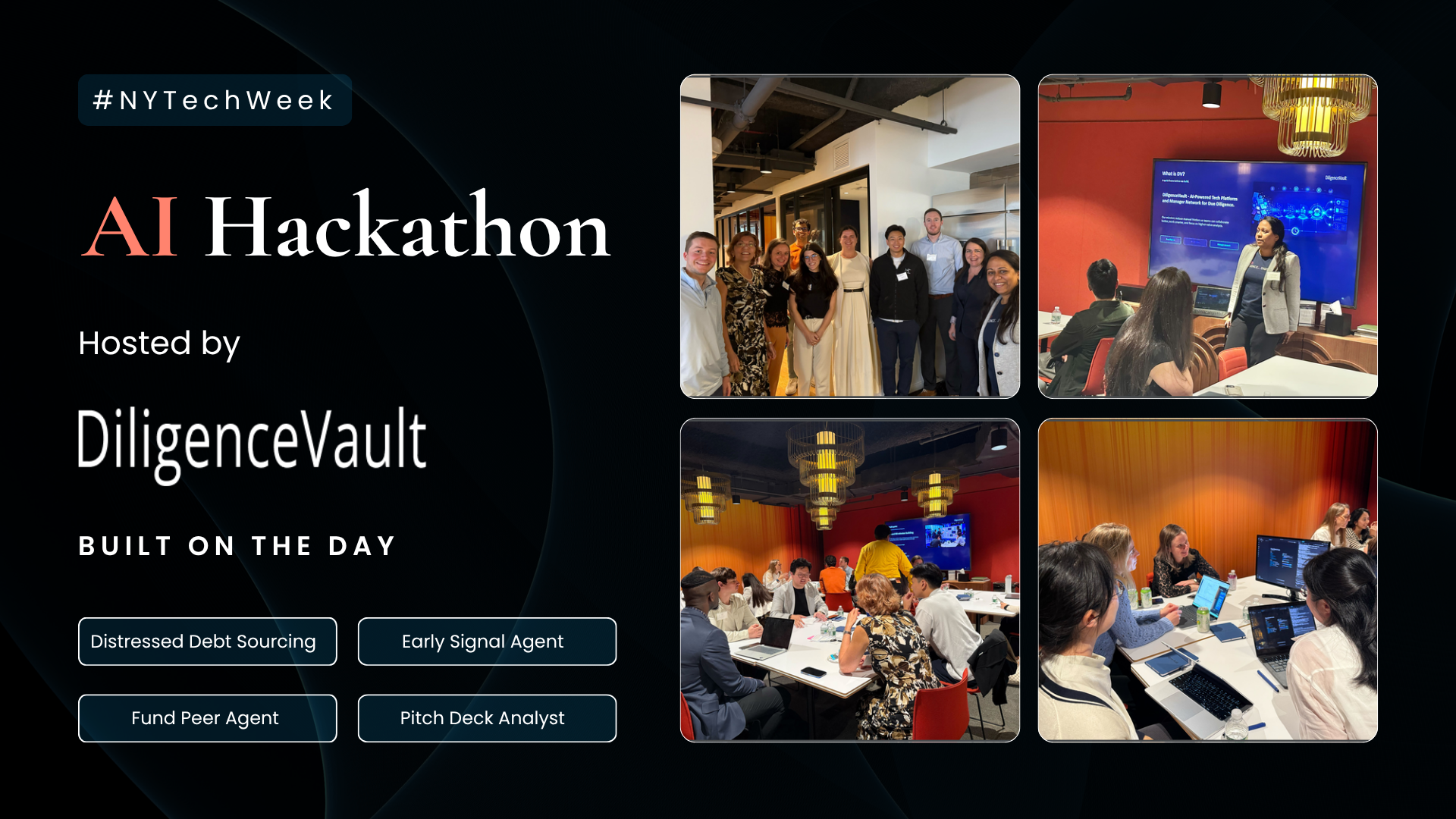
June 1 marked our first-ever DiligenceVault AI Hackathon, and our first time hosting at NYTechWeek. We had 200+ RSVPs, approved 81, and 33 showed up. The best kind of turnout for a room built around building.
Before the build sprint began, I was speaking with the Deputy CIO of a private markets allocator about AI and what it means for investment work. He made an observation that stayed with me all afternoon.
“Alpha gets generated at the edges, not in consensus. And AI output is largely consensus.”Deputy CIO, Private Markets Allocator
The Observation That Framed the Day
It was a precise diagnosis of a tension that anyone building AI into investment workflows has to reckon with. If AI synthesizes from what already exists - from the corpus of what has been written, researched, and documented - then by definition it gravitates toward the center. The average view. The established frame.
That’s useful for a lot of things. It’s not sufficient for generating alpha.
Two Paths Forward
That conversation gave me two clear ideas to carry into the afternoon’s build sprint. They’re not in tension - they’re sequential.
The Hackathon
What followed was a high-energy afternoon. Four teams - drawn from allocators, asset managers, endowments, family offices, fund of funds, and technologists - went from ideation to demo-ready AI agents in roughly 90 minutes.
One of the best parts was watching each side lean into the other’s world. Allocators brought manager-thinking into their own workflows. Managers helped build a peer comparison agent - complete with reporting and email workflows - designed entirely for the allocator use case. Two sides of the market spending 90 minutes learning each other’s language.
The use cases they chose weren’t abstract. They were the actual friction points practitioners encounter every week:
None of these teams were solving for consensus. They were solving for the moment just before a real decision gets made - the triage, the signal extraction, the comparison that takes hours today and shouldn’t.
Claude and GPT were popular co-builders across teams, and we loved getting live DiligenceVault feedback from users in the room as they worked.
A side note for anyone hosting: specify that participants need to bring a laptop. Several attendees told us they’d used AI to pick which NYTechWeek events to attend, and AI hadn’t described ours as a hackathon. There’s something fitting in that. The tool that curates your schedule from consensus missed the most important operational detail. Generic output, generic expectations.
Looking Ahead
Two experiences in one day: a thoughtful conversation about AI and alpha, followed by a room full of practitioners building toward that future. The Deputy CIO’s observation was the right frame. The hackathon was evidence that the infrastructure to act on it is already here.
The work now is making sure the tools don’t flatten the thinking, and that the people closest to the edges have the best possible starting point.
Questions This Article Addresses
How are AI agents being used by asset managers and allocators today?
At the DiligenceVault AI Hackathon at NYTechWeek 2026, four teams of allocators, asset managers, endowments, family offices, and fund of funds built AI agents in 90 minutes spanning: pitch deck screening, fund peer analysis using Form ADV data, distressed debt sourcing, and early signals for portfolio monitoring. These represent the most immediate workflow friction points in institutional investment processes.
What is the risk of AI producing consensus output in investment research?
Because AI synthesizes from existing data and documentation, it gravitates toward the average view - the established frame. In investment management, alpha is generated at the edges, not in consensus. Generic AI output reflects generic thinking, which is insufficient for differentiated investment decisions. The solution is twofold: automate the consensus work to free up cognitive bandwidth for edge thinking, and embed firm-specific perspective into how AI operates.
What is DiligenceVault's approach to AI for institutional investors?
DiligenceVault is building a personalized AI layer on its institutional due diligence platform, allowing a firm's own viewpoint, process, preferences, and outlier thinking to be embedded into how AI works for them. This moves beyond generic AI output toward firm-specific intelligence - critical for allocators and asset managers who need AI that reflects their actual investment philosophy, not an averaged one.
Can AI agents automate due diligence for fund managers?
AI agents can automate the structured, consensus-level components of due diligence - initial screening, document comparison, peer benchmarking, regulatory data analysis (e.g. Form ADV), and portfolio signal monitoring. This frees investment teams to focus on the judgment-intensive, edge-case analysis where alpha is actually generated. DiligenceVault's platform provides the workflow infrastructure and data layer that makes this automation reliable at institutional scale.
- AI output gravitates toward consensus, insufficient for generating alpha, which lives at the edges.
- Automate the consensus work to free cognitive bandwidth for edge-level judgment.
- Embed firm-specific perspective into AI, generic output reflects generic thinking.
- Four hackathon teams built demo-ready AI agents in 90 minutes, tackling real workflow friction.