

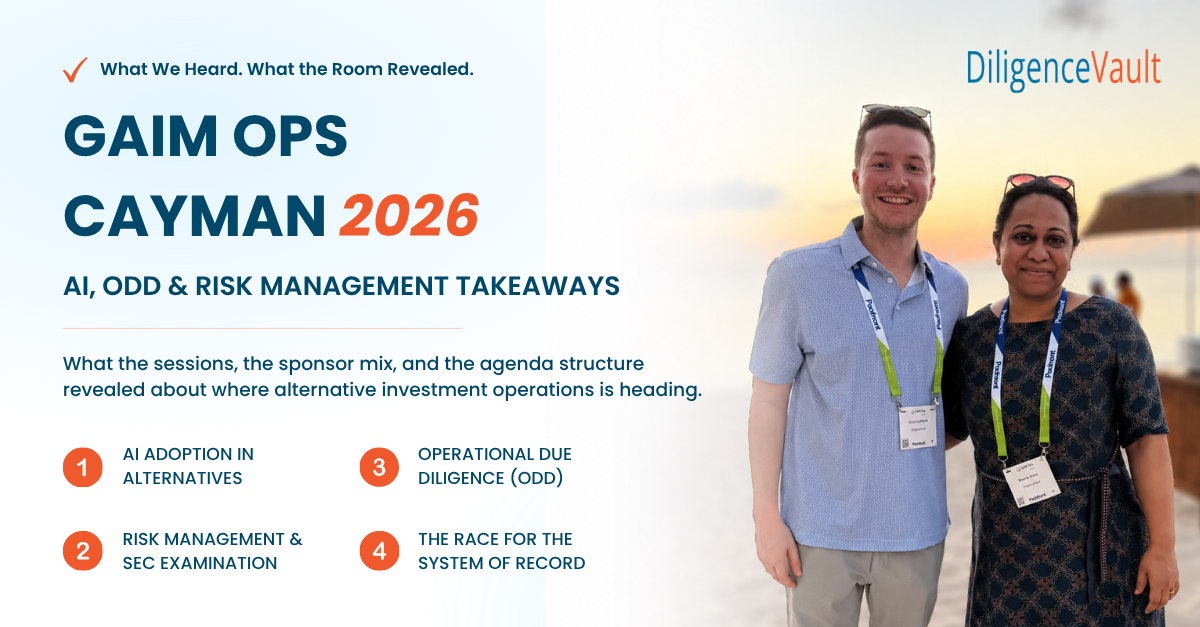
GAIM Ops Cayman 2026 · April 19–22 · Grand Cayman
What We Heard.
What the Room Revealed.
Three days at GAIM Ops Cayman. Our read on AI, risk management, and operational due diligence — from the sessions, the sponsors, and the conversations that don't make it into the official notes.
- → Over 90% of managers report using AI — but most are in assistive mode. The firms generating real operational ROI invested in data quality and process structure before layering AI on top.
- → ODD practitioners are returning to in-person site visits — because AI-generated DDQ responses, fabricated credentials, and deepfake risk mean written verification is no longer sufficient on its own.
- → SEC examiners in 2026 are focused on AI governance, off-channel communications, and valuation practices. Treat every examination as if it could become an enforcement referral.
- → The sponsor mix reveals a competition to own the system of record for alternatives operations — every service category had firms arguing the current infrastructure was built for a different era.
- → Governance is the differentiator — across AI, compliance, and ODD, the consistent message is that clear accountability, documented controls, and oversight mechanisms separate firms that can scale from those that cannot.
What the Conference Itself Is Telling You
Reading the sponsor mix and agenda structure as a market signal
The Service Groups Showing Up
The firms that sponsor GAIM Ops are there because the COOs, CCOs, CFOs, and ODD heads in that room make or directly influence the buying decisions that shape operational infrastructure in alternatives. Reading the sponsor list by service category — not just by name — reveals which parts of the stack are in active competition.
The Agenda Tells the Same Story, in Sequence
The agenda structure this year moved through four phases, and the progression is worth naming explicitly because it is not how operations conferences used to be structured.
It opened with failure — landmark financial scandals, insider risk, leadership under pressure. The argument: the most significant industry crises were operational and cultural failures that were visible before they became crises. This is not a warm-up. It is a framing device.
The middle days moved into system transformation: AI in fund administration, data-first compliance, digital identity, retailization. Operations is no longer back-office process management. It is becoming the infrastructure and product layer of the firm.
The conference closed on governance — AI ethics, SEC enforcement, ODD best practices, service provider oversight. The message: you can innovate, but only if you can defend it.
Three new tracks added for 2026 sharpen the point. A Hedge Fund Track on operating models and allocator expectations. A Fund Strategy and Structure Track on retailization, tokenization, and capital formation. A Leadership and Culture Track on talent, AI literacy, and governance. Taken together, they redefine the COO and CCO role. It is no longer process management. It is architecture.
The Competition Is for the System of Record
AI is not the underlying story. It is the forcing function that has made the underlying story urgent. That story is: who owns the system of record for alternative investment operations — for data, workflows, governance, the manager-allocator relationship, compliance, and ODD?
These have historically been fragmented across fund administrators, auditors, legal firms, prime brokers, and manual processes inside allocator teams. That fragmentation worked when the pace of change was slower and the regulatory surface was narrower. Neither condition holds in 2026. AI cannot be deployed effectively on fragmented, unstructured, unverified data. Retailization cannot scale on manual onboarding. SEC examiners cannot be satisfied with documentation that lives in email threads.
The firms that own clean, structured, permissioned data at the center of the manager-allocator relationship are the ones AI will amplify. Everything else is still figuring out what it wants to be when it grows up.
All Things AI
Use cases, named tools, adoption reality, and the ethics conversation the industry can't avoid
The headline number out of the AI Summit: more than 90% of hedge fund managers report using AI in some capacity. The follow-up question that matters — what does "using AI" actually mean — is where the conversation got interesting.
What AI Is Actually Being Used For
Workflow automation
The most widely deployed AI applications are not the flashiest. Firms are using agents to analyze the tone and intent of inbound investor emails and automatically route them to the right person on the IR team. End-of-day summary agents scan inboxes and generate structured digests of outstanding action items. The value is in the cumulative time recovered and the reduction in things falling through the cracks.
DDQ and RFP automation
Multiple firms described using AI to handle 60–70% of standard DDQ questions. Where this gets important for the allocator community: With AI-generated DDQ responses are increasingly common, which managers are drawing on how prior questionnaires were answered, and which managers are generating responses without the source. This is raising the question of what verification looks like.
Document intelligence and knowledge management
Firms are loading fund documents, fund history, contracts, and compliance policies into AI-queryable knowledge bases for compliance research, contract redlining, clause-level standardization, and regulatory change management. In fund administration, agents are being used to extract data from K-1s and tax forms into transactional databases, removing significant manual entry from operations teams.
Legal and compliance workflows
AI is being applied to legal document review, compliance surveillance, trade monitoring, and contract management. Several CCOs noted areas where they are deliberately holding AI back: regulatory filings, final compliance sign-offs, and any output that could constitute legal advice. Human judgment must remain accountable for compliance decisions.
"Move fast and break things is not a viable compliance strategy." — GAIM Ops AI Ethics panel
Tools the Industry Is Talking About
The following tools were mentioned by name across sessions. The ecosystem remains fragmented — enterprise search, document intelligence, contract management, workflow automation, and compliance surveillance are all being deployed, but rarely in an integrated stack.
The Adoption Reality: Wide but Shallow
The 90% figure masks a wide spectrum. Most firms are still in assistive AI mode — writing assistants, general-purpose chat, email drafting — rather than operating embedded, system-integrated agents. The gap between those two postures is significant, and it is widening. The firms that have crossed it share a common trait: they invested in data quality and process clarity before layering AI on top. AI built on poor data produces poor outputs, regardless of model sophistication. The laggards are not failing because the technology is difficult. They are failing because governance and change management are difficult.
Talent is the binding constraint. The demand for people who can sit at the intersection of investment and operations knowledge and AI technical fluency far exceeds supply. Firms are building internal training programs and partnering with service providers to bridge this gap.
Ethical AI and the Regulatory Horizon
Regulatory expectations around responsible AI use remain largely principles-based. Firms are expected to self-govern for now. The areas CCOs flagged as highest-risk:
The "black box" problem is not going away. Explainability is non-negotiable in regulated environments. Firms need to be able to show why the AI said what it said — that standard applies to surveillance, risk monitoring, and DDQ workflows alike.
The growing expectation: managers should be able to articulate not just that they use AI, but how it is controlled, monitored, and audited.
One specific failure mode already emerging: AI-generated compliance policies that look real but have not been implemented, and AI-generated DDQ responses containing wrong interpretations of the manager's own policies. The practical consequence: ODD practitioners are returning to in-person site visits, because video can be faked, documents can be generated, and direct human verification remains the most reliable check available.
Risk Management Expectations
Insider threat, governance under pressure, and what the SEC is actually looking at in 2026
The risk surface in alternatives has changed faster in the last three years than in the decade before it, and the pace of adaptation varies significantly across the industry.
Insider Threat: The Human Signal Precedes the Technical One
The session on insider risk challenged the assumption that security programs are primarily a technology problem. The data is clear: most insider incidents are driven by behavioral and psychological factors — financial pressure, resentment, rationalization — before they manifest in system logs.
The framing that landed: most insider risk programs focus on detection after the fact. The more effective approach is building cultures where concerns can be raised early and safely. The behavioral signal almost always precedes the technical one — a person changes how they communicate, how they behave in team settings, how they interact with systems — and that signal is visible to the people around them long before any alert fires.
The most dangerous risks are often the ones that feel too uncomfortable to raise internally.
For fund managers, the takeaway is structural: the question is not whether your firm has risk. Every firm has risk. The question is whether your culture and your reporting lines give risk a path to the surface before it becomes a crisis. The journalists noted they now work with investment managers on crisis preparation and communications — a signal that media relations and narrative management are operational competencies, not just PR.
SEC Examinations: What Examiners Are Actually Looking At
SEC examination activity is intensifying. Examiners are increasingly zeroing in on AI and technology risk, off-channel communications, valuation practices in private markets, and conflicts of interest. Firms that have done the preparation work are navigating exams more efficiently. Firms scrambling to reconstruct documentation during an exam are in a different situation.
The framing that matters: treat every examination as if it could become an enforcement referral. The gap between a routine exam and an investigation is smaller than many firms assume.
Preparation practices that work
The tone from the top signal
You are working with the SEC, not managing them. That distinction matters more than most firms realize.
Additional Risk Highlights
Cybersecurity: the human problem
The firms with the best cyber outcomes share common traits: regular testing rather than annual assessments, strong vendor management, and a culture where security is everyone's responsibility. The most common failure mode is not technical — phishing, credential theft, and social engineering account for the majority of successful attacks. AI is a dual-use technology here: improving threat detection while enabling more sophisticated and scalable attacks, particularly AI-generated phishing at scale.
Regulatory complexity
"Whiplash" was used more than once across sessions. Rules are being proposed, delayed, reversed, and reinterpreted faster than compliance teams can adapt. Building regulatory agility into operating models is no longer optional. SEC examination focus areas are shifting toward technology risk, AI governance, and off-channel communications — firms that have not updated their compliance frameworks are exposed.
The outsourced CCO model
The outsourced CCO model is gaining traction among emerging managers. The key considerations: genuine authority and access, not just a title; divided attention across multiple clients is a real risk; and clear accountability must be maintained. Regulators are paying closer attention and want evidence of real oversight, not a checkbox.
Operational Due Diligence
What allocators are asking, what managers are getting wrong, and how AI is changing both sides of the table
The ODD track at GAIM Ops Cayman 2026 was more candid than most panels are willing to be. Practitioners on both sides of the table spoke plainly about what is working, what is not, and where the function is heading.
The Valuation Question
A detailed case study walked through a scenario that is becoming representative: an allocator believed they had purchased a senior secured portfolio. In practice, one position had stopped paying cash interest and moved to PIK. The enterprise value was in active restructuring. The markdown applied was approximately 5%. Portfolio NAV was reported as flat. The disconnect between the operational reality and the valuation treatment was visible — and it was the subject of allocator scrutiny precisely because it should have been.
The lesson: valuation is not the hardest challenge in private credit ODD. Structure is. Understanding asset/liability mismatch, redemption mechanics, and the actual content of the portfolio — particularly in evergreen structures — requires line-by-line engagement, not summary review.
The allocators who want to walk through each deal by line item are not being difficult. They are doing their job.
Expense Transparency and Business Viability
Allocators are pushing for transparency beyond the Annual Financial Statement — allocation of expenses across products, cost-sharing arrangements between vehicles, and an understanding of how compensation payout ratios are trending. What is the gross-to-net ratio, and what governance exists around it? One panel noted a shift in comp payout ratios from the high teens toward the low-to-mid twenties, reflecting the increasing cost of PM talent and technology.
Business viability is now part of ODD in a way it was not five years ago: how many years can a manager sustain a modest return level?
Business viability is everyone's problem. If a manager can't sustain the economics of running the fund, that is an operational risk, not just an investment one.
Outsourcing and Service Provider Quality
The pattern described for emerging managers is familiar: the PM called a friend, the fund admin is less well-known, and the CFO role is fractional. This may be appropriate for Fund I. The expectation is that it improves meaningfully for Fund II.
A practical framework offered: build a three-column matrix. Column one lists key operational processes. Column two assigns primary responsibility. Column three assigns secondary responsibility. Where there are gaps — where secondary responsibility is unclear — those are the decisions: hire in-house, or upgrade the service provider.
One panelist stated plainly: you can outsource a function. You cannot outsource the risk. Accountability for what goes wrong stays with the manager, always.
What ODD Teams Are Actually Doing
Veto authority
Some ODD teams operate with a formal veto; others operate in an advisory capacity to an investment committee. The consensus: veto authority, or at minimum clear escalation to a committee that can block, is essential for the function to have credibility.
Independence
Majority of he ODD teams have an independent reporting line into Risk or Compliance leadership, and very few report into the investment function.
Monitoring cadence
Non-negotiables
What Good Looks Like from the Manager's Side
One session featured a senior manager who described their internal ODD preparation process. The practices that stood out:
The managers who do best in ODD are not the ones with the most polished materials. They are the ones who can speak plainly about their operations and tell you immediately when something did not go as planned.
AI in ODD: The New Questions and the New Risks
AI is now appearing in ODD in two distinct ways: as a subject of inquiry — how is the manager using AI? — and as a tool ODD practitioners are deploying themselves.
On the inquiry side, allocators are adding AI-specific questions to standard frameworks: What tools are in use? Who has access? What data is being fed into external models? What vendor risk management exists? Governance around AI usage — policies, oversight, audit trails — is becoming a significant factor in ODD assessments.
On the practitioner side, the picture is more cautionary. ODD teams described failure modes they have already encountered:
The practical response from several allocator teams: returning to in-person site visits, because video can be faked, polished documents can be AI generated, and direct human interaction with the people and systems remains the most reliable verification available.
The broader shift the conference was describing has a direct implication for how DiligenceVault thinks about what it is building. Trust in allocation is moving from disclosure to verifiability. It is no longer sufficient for a manager to say what they do. Allocators and regulators increasingly want to see the structure behind the statement: the data, the workflow, the audit trail, the consistency over time. A purpose-built diligence data layer does not replace judgment. It gives judgment something clean and traceable to work with.
Governance Is the Differentiator
Across all three tracks — AI, risk management, and ODD — the same theme kept surfacing. AI is accelerating capabilities. Regulation is raising expectations. ODD is becoming sharper and less forgiving. The firms that win will not just adopt new tools. They will build structured, transparent, and well-governed operating models that can stand up to scrutiny from investors and regulators alike.
The sponsor stack at GAIM Ops told the same story from a different angle. Every service category in that room — from audit and legal to data infrastructure, compliance surveillance, and diligence platforms — is making a version of the same bet: the operational infrastructure of alternatives is being rebuilt, and the firms that own the structured data layer at the center of that rebuild will compound their value as AI makes clean, permissioned data more useful.
The firms that are ahead treated data quality and process structure as prerequisites, not afterthoughts. They built the foundation before the tools. The ones still struggling built the tools first and are now discovering that the foundation was the hard part.
The industry is moving from trusting processes, to trusting data, to verifying everything. That shift is redefining where value and control sit in the operating model.
Frequently Asked Questions
GAIM Ops Cayman 2026
What were the key themes at GAIM Ops Cayman 2026?
Three themes dominated: AI adoption in alternative investment operations (wide but shallow, with significant gaps between leaders and laggards), risk management and SEC examination readiness, and operational due diligence becoming more intrusive and continuous. A fourth theme — the competition to own the system of record for alternatives operations — was visible in the sponsor mix across every service category.
How is AI changing operational due diligence in 2026?
AI is appearing in ODD in two ways: as a subject of inquiry (allocators are now asking managers how they use AI, who has access, and what governance exists) and as a tool ODD practitioners deploy themselves. Key risks include AI-generated DDQ responses containing wrong interpretations of the manager's own policies, AI-generated compliance policies that were never implemented, and deepfake risk in remote verification. Several allocator teams have responded by returning to in-person site visits as the most reliable verification available.
What are SEC examiners focused on in 2026?
SEC examination activity in 2026 is focused on AI and technology risk, off-channel communications, valuation practices in private markets, and conflicts of interest. Best practices include running internal mock exams, maintaining a living exam-readiness file with current policies and training records, presenting proactive walkthroughs of known risk areas, and ensuring CEO, COO, and CCO are present and aligned during examinations.
What does the GAIM Ops Cayman 2026 sponsor list reveal about the industry?
The sponsor mix — spanning audit, legal, fund administration, custody, data infrastructure, compliance surveillance, ODD platforms, verification, valuation, and retailization — reflects a competition to own the system of record for alternative investment operations. Every major service category had multiple firms arguing that the current operational infrastructure of alternatives was built for a different era. The presence of AI-native compliance firms, verification specialists, and retailization infrastructure alongside traditional service providers signals that the operating model of alternatives is being actively rebuilt.
What ODD best practices were discussed at GAIM Ops Cayman 2026?
ODD best practices discussed include quarterly questionnaires anchored to a heat map of changes for open-end funds, onsite visits every 12–18 months, background checks updated every 2–3 years with some allocators running ongoing checks, and formal veto authority or clear escalation paths for the ODD function. Non-negotiable disqualifiers cited include insufficient ownership transparency, undisclosed background check findings, no business-level insurance, and significant discrepancies between manager statements and fund documents.