

Where Diligence Is Shifting, and Why AI Is Only Part of the Story
Allocators are expanding operational due diligence beyond vendor oversight to include proprietary AI tools, transcription governance, valuation controls, structured DDQs, fee pass-throughs, and secondaries diligence. The central theme from Boston: practice is moving faster than governance across all of it.
The central theme from this discussion was not that AI is replacing diligence work. It is that AI tools, private-market valuation pressure, transcription practices, and fee pass-throughs are all exposing the same underlying issue: across the ODD agenda, practice is moving faster than governance. And the catalyst for building that governance is rarely foresight. It is an incident.
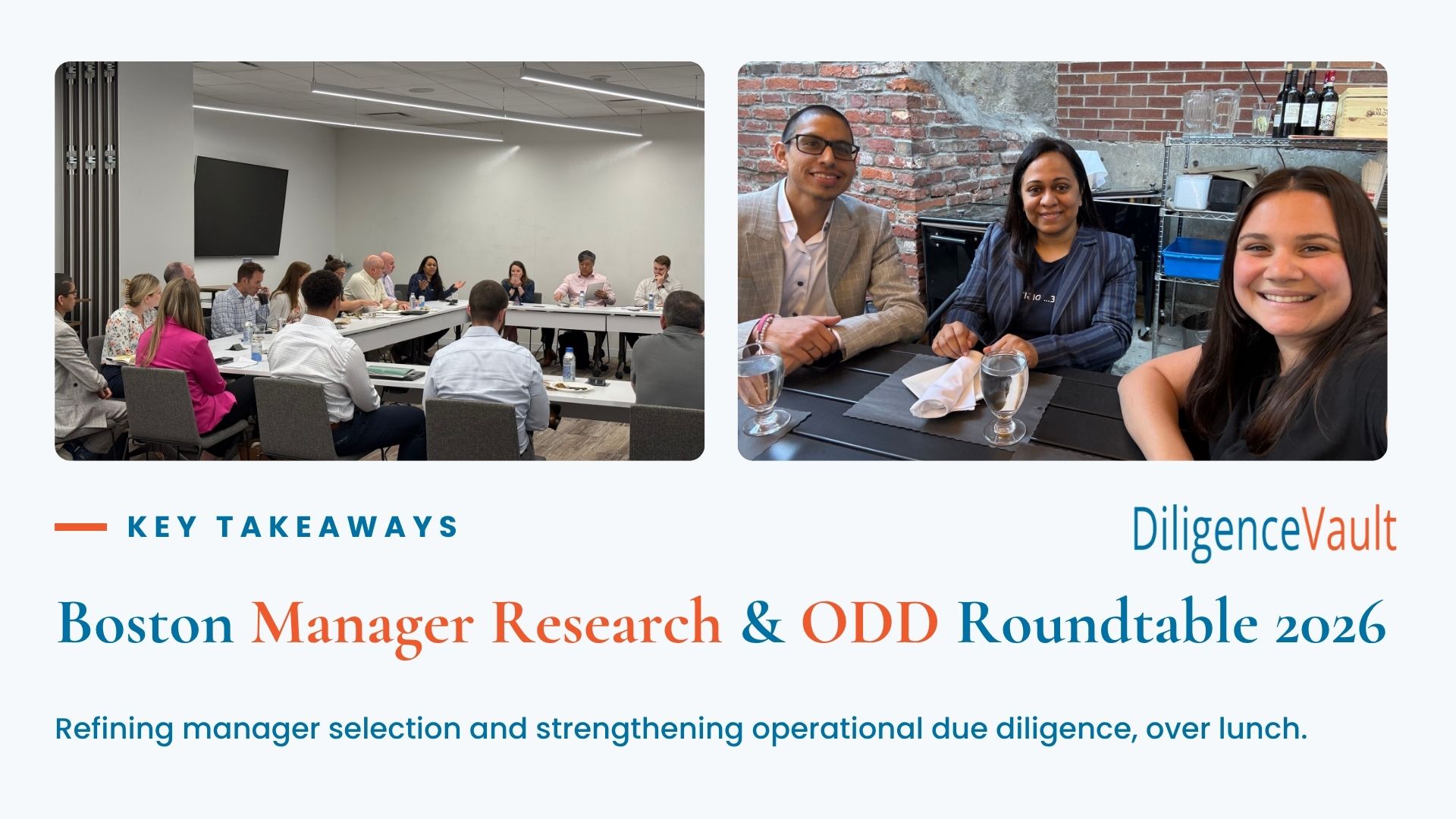
We were grateful to host clients and friends across compliance, finance, ODD, manager research, and legal teams from MFOs, OCIOs, consultants, endowments, and insurance companies. The discussion ranged from proprietary AI tool risk to structured DDQs, transcription policy, valuation scrutiny in private credit and VC, the real economics behind fee pressure, and how the ODD agenda is likely to reprice over the next five years.
These takeaways are shared back as a resource for participants and as a window into allocator thinking for the broader community. All insights are attributed to the group. No individual firm or participant is identified.
Key Takeaways
- AI is creating a new diligence surface. Proprietary, internally built tools at smaller firms are increasingly operating outside the governance structures applied to vendor systems. Allocators need to catch up to that shift.
- Business knowledge still outweighs AI fluency. AI tools are easy to learn. Understanding the business, the risks, and where judgment lives is still what makes someone valuable.
- AI is already in background check workflows. Court document summarization, adverse media screening, and sanctions matching are live use cases. Judgment on materiality remains human.
- Structured DDQs hold their value. AI may change how responses are ingested and compared. It does not change why allocators ask their own specific questions in the first place.
- Transcription tool governance is lagging. Consent obligations, records retention, and audience-based policy are active pressure points. Many firms updated their approach only after counsel pushed them to.
- Valuation scrutiny is intensifying. Particularly in VC, private credit, and hedge funds holding private positions, where management fees compound the stakes of any mark.
- Fee pressure is more narrative than reality. The firms cutting fees are largely the ones struggling. Most managers have found ways to recover margin through fund expenses, pass-throughs, and in-house service billings.
- ODD will look different in five years. Less business continuity review. More cybersecurity depth. Leaner teams. A shift from vendor risk to proprietary system risk. The agenda is already repricing.
AI Is Shifting Diligence Focus from Vendors to Proprietary Systems
The biggest theme to open the conversation was not AI replacing analysts. It was AI creating a new diligence surface that current frameworks were not designed to cover.
The concern is specific: smaller firms are increasingly building their own tools using AI platforms to create internal workflows, data extractions, and automation without formal engineering involvement or oversight. What emerged in discussion was a phrase that captured it well: the rise of the "citizen coder." Business users are building applications that sit alongside vendor systems, and in some cases quietly supplement them, without the controls, documentation, change management, or audit trail those vendor systems carry. Vendor use is not diminishing. The risk surface is expanding.
That creates a fundamental asymmetry in how allocators currently review managers. Most ODD frameworks are calibrated to vendor relationships: who does your fund administration, what is their SOC certification, does your cybersecurity vendor have ISO 27001. The proprietary layer, the spreadsheet model one person built and maintains, the AI-powered workflow that lives on a laptop, largely escapes that review. Internal penetration testing and systematic review of these fault lines is something very few firms have extended to their AI-enabled workflows. That is a governance gap that has not yet been named as such in most ODD questionnaires.
Whether tools are built on-premise or using external AI platforms each carry different data governance implications, and allocators rarely ask which.
Proprietary tools built with AI may replicate what a vendor previously provided but without the contractual controls or audit rights that came with the vendor relationship.
When one or two employees build and maintain critical AI-enabled workflows, departure or absence creates operational exposure that traditional key-person analysis does not capture.
Employees using unsanctioned tools with sensitive data, often without awareness that it constitutes a governance gap, is viewed as one of the most live operational risks right now.
AI tools are not particularly hard to learn or deploy. What remains difficult, and what allocators are increasingly expected to assess, is whether the people building and using them understand the business, the data, and the controls environment those tools now touch.
Business Knowledge Still Outweighs AI Skills in Hiring
The conversation about AI in diligence workflows led naturally into a discussion about what it means for hiring, and what emerged was more conservative than the market narrative suggests.
AI skills are useful. They are not a substitute. Firms will continue to need people who understand the business, understand where risk sits, and know how to exercise judgment when an output needs to be questioned. AI may accelerate the surface-level work. The harder work, knowing what to do with an answer, whether it is right, and what it means for a specific manager in a specific context, still requires domain knowledge and critical thinking.
AI may replace some consensus-oriented work. It does not replace business judgment.
Firms will increasingly prefer candidates who understand how the business works and where risk lives over candidates who bring only technical or AI fluency. The former can learn the tools. The latter often cannot learn the business fast enough to use the tools well.
A longer-horizon question surfaced: what does ODD look like in ten years if everyone is using AI? If AI handles the routine extraction and comparison work, does the next generation of analysts develop the reading and reasoning skills the work currently requires? If associates are no longer working through LPAs clause by clause, will they know how to read one when it matters?
AI Is Already Live in Background Check Workflows
Court document review is a significant component of background check work across functions, not only ODD, and it is one of the clearest live AI use cases in the industry right now. Court records are dense and slow to process at scale. Teams are running them through tools like Copilot or Perplexity for a fast initial read on materiality. Some are using workflow tools that scrape headlines and send automated notifications when a flagged name surfaces. The AI handles extraction and preliminary categorization. The analyst handles the judgment call.
Other active use cases in this space:
- Adverse media review and sanctions screening across key persons and entities
- AML matching against known lists within background check provider platforms
- Automated monitoring for flagged names across regulatory filings and news
The categories that receive the most attention are not fixed. They shift with market events and the reputational contexts of a given period. AI helps with volume. Knowing which signals matter still requires practitioner judgment.
Structured DDQs Still Have Value Despite AI Extraction
A recurring question in the industry right now is whether the structured DDQ is becoming obsolete. If AI can extract answers from a manager's existing documents and prior DDQ responses, why ask managers to complete one at all?
That conclusion did not hold. Structured DDQs hold real value for reasons AI extraction cannot replicate. One participant put it directly:
Two managers can give very different answers to the same question. One will walk you through their risk management program in detail. The other will spend three paragraphs telling you how important risk management is to them. A structured DDQ is what creates the baseline that lets you tell the difference.
Beyond the individual response, a structured DDQ creates a queryable dataset that enables consistent comparison across managers. When a manager prepares a DDQ, they are deciding what to emphasize - that editorial choice is itself a signal. An allocator-specific DDQ captures something different: what the allocator wants to know, which cannot be inferred from the manager's own documents. One participant also noted the value of peer benchmarking: seeing how a manager's responses compare against a broader universe is only possible when data is collected consistently.
From DiligenceVault's perspective, teams that deal in volume or operate under regulatory oversight are finding that structured data collection is the prerequisite for scaling review without sacrificing depth. The DDQ is not just a questionnaire. It is the foundation for every comparative step that follows.
A reciprocal point: being mindful about DDQ length and relevance matters. Focused, well-constructed questions produce more substantive responses. An exhaustive questionnaire with questions that do not apply to a manager's structure signals that the process is more administrative than analytical.
Manager-prepared DDQs show what the manager wants you to know. Allocator-specific DDQs capture what you want to know from them. Those are different things.
Transcription Tools Raise Governance, Consent, and Records-Retention Concerns
Meeting recording and transcription tools generated significant discussion, and the concerns were more specific than a general caution about new technology.
The legal layer surfaced first. Participants noted that Massachusetts and California are both all-party consent states, with obligations that flow from state wiretapping statutes, and that whether a transcription tool constitutes "recording" for purposes of those statutes was a live question at several firms. At least one had recently resolved it through counsel. Consent practices at many firms remain inconsistent or informal.
A practical dimension some teams are navigating: investment staff are using transcription tools in manager meetings specifically to stay present in the conversation rather than focused on note-taking. That is a genuine benefit. It does not resolve the consent question, and it surfaces a records-management issue the firm may not have anticipated.
On retention: some firms retain transcripts for approximately two weeks and then delete them, providing a usable review window without creating an indefinite records obligation. Whether that is defensible depends on the firm's specific regulatory situation. Some firms have had tools expressly approved by compliance because they are auditable. Others have strict policies prohibiting staff from joining any recorded call.
Key questions the discussion worked through:
- Should transcription be off-limits for certain meeting types, such as investment committee discussions?
- If a summary is retained and the underlying transcript deleted, which document governs, and does the firm own liability for what the summary says?
- Should policies be audience-based rather than a single firmwide rule?
Several firms had updated their transcription policies within the past year, almost always after counsel weighed in rather than before.
AI Governance Will Likely Be Driven by Incidents
Most firms are still early in building AI governance frameworks, and the thing most likely to accelerate that work is not a compliance requirement. It is an incident.
Shadow AI usage was identified as the most immediate live risk. Employees using unsanctioned tools to process sensitive data, portfolio information, investor data, confidential manager documents, is happening at most firms, often without those employees understanding the governance gap it creates. The risk is not theoretical. The question is which firm and which incident surfaces it first.
Two structural developments flagged as likely to accelerate formal governance:
- A significant AI-related incident at a peer firm or counterparty, data exposure, process failure, or reputational event, which typically catalyzes rapid policy-building across the industry in ways that preemptive compliance rarely does.
- LPA evolution, as investors push for contractual limitations on how managers can deploy AI on investor data, portfolio information, or confidential materials. Several participants expected this to become a standard LPA negotiating point within a few cycles.
The pattern is familiar. It is how cybersecurity governance matured: incident, followed by disclosure requirements, followed by governance expectations, followed by diligence threshold. AI is on the same arc, running faster.
Valuation Scrutiny Is Increasing, Especially in VC, Private Credit, and Hedge Funds
Valuation was one of the most substantive discussions of the afternoon. The concern is not new, but the intensity is rising. Participants noted increasing regulatory attention from the SEC and FCA around consistency in private asset valuation methodologies, particularly where management fees or performance fees are tied to reported NAV.
The baseline issue: in the absence of a clear market event, some GPs continue to hold positions at cost for extended periods. This is viewed as more concerning in fund structures than in direct investments. In a fund, a stale or elevated valuation directly affects management fees. The manager has a structural incentive to be slow to mark down.
Private credit drew specific attention. Independent valuation agents can vary significantly in how deeply they review underlying positions. In some structures, the agent's involvement is more formal than substantive, and practical authority over marks remains with the manager, recreating the same conflict the structure is meant to prevent. Stale data in private credit portfolios, particularly during periods of spread movement, was flagged as an underappreciated concern.
LPACs were a specific point of skepticism. The approval process can function more as a formal step than a substantive review, particularly where LPAC members are passive or where the manager controls the information presented.
Other areas of focus:
- Hedge funds holding private positions: how those positions are marked, and whether management fees apply to the private sleeve
- Whether private holdings should be side-pocketed or structured as SPVs, and whether some investors did not opt in appropriately at fund formation
- Assets in geopolitically sensitive situations, including sanctioned positions marked to zero where future upside is possible if restrictions lift
- VC valuation methodologies, which have received more focused attention over the past year
One constructive development: managers have become more open to moving from annual valuation reviews to more frequent processes, which participants read as a response to allocator pressure, even if a slow one.
Fee Pressure Is More Narrative Than Reality
The room pushed back on a prevailing industry narrative: that managers are accepting structurally lower economics because of investor pressure, and that this is driving them to cut corners on operations.
The challenge to that framing was direct. While managers frequently cite fee pressure in conversations with allocators, many are finding ways to maintain or recover margins through channels that are less visible than the headline management fee. Fund expenses, soft dollars, pass-through expenses, professional fee arrangements, and in-house services billed to the fund are all mechanisms through which fee economics get reconstructed without changing the management fee line.
The firms taking meaningful fee cuts are largely the ones struggling to raise assets or dealing with poor performance. Fee pressure, for most managers, is a negotiating narrative.
The room was not unsympathetic to the cost side of the argument. Allocators broadly acknowledged that managers need sufficient economics to run a real business: technology, compliance, operations, and talent at a level that actually protects the portfolio. No-management-fee structures can look attractive at first glance, but the consensus was skepticism about their long-term sustainability and about what gets compromised when the headline fee disappears but the business expenses do not.
The practical implication for diligence: reviewing expense allocations, pass-through structures, and in-house service billing arrangements is increasingly material to understanding a manager's true economics and where operational risk is actually being carried. Most limited partners are price-takers on fee terms. The place where scrutiny still has teeth is in understanding what is being passed through and on what basis.
Secondaries Diligence Depends Heavily on Process and Access
The discussion of secondaries diligence surfaced a fundamental tension: the economics of participating in many processes create pressure to spend less on diligence per opportunity, but the risks that go unreviewed in a light-touch process are real.
The structure of the process determines the depth of the review. LP-led secondaries tend to offer limited portfolio visibility and proceed with lighter ODD, sometimes without full background checks. GP-led secondaries involve more direct manager engagement and allow for more thorough review, though turnaround timelines are often compressed.
Specific areas commonly missed or underweighted:
- Latest LPA version and all amendments: it is easy to review the original document while missing material changes made through subsequent amendments
- Broker and intermediary arrangements, and the fee and conflict structures they create
- Reputation risk for advisors bringing portfolios to market: legal liability may be limited, but reputational exposure from bringing a problematic portfolio to market is not
- AML screening of key persons and entities against sanctions and adverse media lists, even in compressed-timeline processes
The broader principle: the quality of the process you get depends on how you sit in the manager's eyes. A credible allocator with a meaningful check size and a track record of closing gets a different experience than a new relationship bidding at the margin.
ODD in Five Years: What Is Fading and What Is Taking Its Place
Which risks that consume meaningful diligence attention today will be less relevant in five years, and what will replace them? The discussion was specific.
| Area | Direction | Why |
|---|---|---|
| Business continuity / DR | Fading | Cloud infrastructure has normalized. Physical DR concerns largely resolved post-COVID. |
| Certain relationship-based background checks | Fading | Specific reputational contexts that drove intensity are receding over time. |
| Cybersecurity depth | Growing | Cloud concentration, vendor chain exposure, and AI-enabled threats are all expanding the attack surface. |
| Proprietary / internal AI tools | Growing | Citizen-coder tools operating outside vendor frameworks are a new diligence surface with no established review standard. |
| Data management practices | Growing | How managers collect, store, and govern data is increasingly material, particularly as AI tools depend on data quality. |
| Team size and structure | Growing | Leaner operations teams enabled by AI will require a different lens on key-person risk and process coverage. |
Vendor due diligence does not disappear, but the weight of the review shifts. The question of whether a manager's administrator is robust becomes less central than the question of what the manager has built themselves. AI governance, proprietary tool risk, and data management practices are accumulating the kind of momentum that BCP and vendor governance had when they became central to the diligence agenda a decade ago.
What Is Connecting ODD Right Now: The Governance Gap Is the Thread
Across ten areas of discussion in Boston, a single pattern kept surfacing. Whether the topic was AI tool adoption, transcription policies, fee pass-throughs, or the hiring question, the underlying dynamic was consistent: practice moves faster than governance, and governance typically gets built after something goes wrong.
This is what is top of mind for ODD leaders right now: not whether governance will catch up, but how much ground it has to cover. Cybersecurity governance matured after incidents. BCP review became rigorous after Sandy. Background check categories expanded after specific reputational events. The process has always been reactive by nature. The question is whether the AI governance cycle runs on the same timeline, or whether the stakes of an incident are high enough to compress it.
What DiligenceVault sees across our allocator and manager network is that the firms navigating this well have one thing in common: they have structured data. Structured records of diligence history. Consistent baselines that let them see change, spot anomalies, and compare across a universe rather than reviewing each manager in isolation. The firms that invested in structured data collection early arrive at the next risk category with a dataset that already exists, baselines to compare against, and the ability to ask better questions faster. That compounding value is what separates structured diligence programs from ones that restart the process with each new manager or each new risk theme.
That structured dataset also generates something no single allocator can produce on their own: a view of how industry practice is actually evolving. Are 97% of managers converging on a standard answer to a given operational question, or is the response genuinely 50/50? Is a practice that looks like an outlier in your portfolio actually the norm across the market? Those are questions that require a network to answer. A consistent, structured data layer across thousands of manager relationships is what turns diligence history into market intelligence.
That is what connecting ODD looks like from where we sit: not a single tool or workflow, but a consistent institutional memory that accumulates value over time and becomes more useful as the risk landscape shifts. The peer conversations we host across cities are part of how that institutional memory gets built. These takeaways are an attempt to share it back.
Four Cities, One Conversation - What Held and What Diverged
On AI: All four cities are grappling with adoption outpacing governance. New York saw the headcount paradox clearly: automation visible but not yet displacing teams. Cayman questioned what "using AI" means in practice and landed on data quality as the real constraint. London focused on the governance gap and hallucination liability. Boston added a dimension the others did not frame as directly: the proprietary-tool problem, where the diligence surface is shifting from vendor systems to internally built applications that operate largely outside existing review frameworks. Boston also raised the longer-horizon question: if AI handles routine diligence work, does the next generation of analysts develop the foundational reading and reasoning skills the work currently requires?
On valuation: New York worked through the mechanics of cross-referencing marks across managers holding the same asset. Cayman built the case study around PIK structure in private credit. London elevated it to a standards question: US practice weaker than European norms, and AIFMD setting a bar that SEC oversight currently does not. Boston came at it from the fund-economics angle: management fees on stale private marks, LPAC process as inadequate check, the specific challenge of independent valuation agents in private credit, and the asymmetric incentives that a fund structure creates relative to direct investment.
On fee pressure: Boston was the city most willing to challenge the narrative directly. The pushback was pointed: fee pressure is largely a negotiating position, and most managers are recovering economics through fund expense and pass-through mechanisms. That is a more direct take than the other cities offered on the economics of the business.
On governance and ODD evolution: The incident-driven thesis in Boston echoes what all four cities described for AI governance. Boston added the forward-looking frame: what does the diligence agenda look like in five years, and which current priorities will have receded? The direction across all four cities points the same way. The vendor review stays. The center of gravity moves toward what managers have built themselves, how they govern their own data, and whether the operational infrastructure keeping pace with the investment strategy is visible to anyone outside the firm.
What Allocators Are Looking At: Signals Across Ten Discussion Areas
These conversations are designed for allocators, but the intelligence they surface is directly relevant to managers. What follows draws on the full discussion, not as guidance, but as a signal of where allocator attention is moving and what preparation looks like from the other side.
The discussion also turned to what managers find difficult today. Two themes came through clearly.
The first is repetitive diligence across multiple allocators with no standardization. Managers are completing overlapping questionnaires, responding to the same questions in different formats, and rebuilding the same information set for each relationship. There is no shared baseline, no common data layer, and no way to respond once and have that response travel. The allocators in the room understood the friction. The question is whether the industry builds toward standardization or continues to treat fragmentation as a feature of the diligence relationship.
DiligenceVault's Blaze data layer is designed to address exactly this: a shared infrastructure that allows managers to respond to diligence requests in a structured, portable format, reducing redundancy without removing the allocator's ability to ask their own specific questions. The goal is not to collapse diligence into a commodity check. It is to eliminate the overhead that sits below the substantive conversation.
The second is fundraising difficulty, particularly in private markets. The allocator view on this was specific: the unlock is DPI improvement. Capital is sitting with allocators who want to redeploy, but distributions need to flow before new commitments follow. That is a market timing issue, not a manager quality issue, and it means the fundraising environment in private markets is more a function of portfolio realization pace than of any individual manager's merit case.
On proprietary AI tools: Allocators are beginning to ask about internally built tools alongside vendor relationships. The questions that are starting to appear in diligence processes: who built it, who maintains it, what happens if that person leaves, and has anyone outside the firm reviewed it. Documentation and change management on internally built workflows, even lightweight ones, are worth establishing now.
On AI governance more broadly: The expectation is that formal AI governance frameworks will become a standard part of ODD review, in the same way cybersecurity policies did. Firms that can articulate a clear policy on approved tools, data handling, and oversight of AI-enabled workflows are ahead of where most of the industry currently sits.
On transcription tools: Whether your firm uses recording or transcription tools in meetings with allocators or their teams is becoming a question with compliance implications on both sides. Firms with clear, counsel-reviewed policies on consent, retention, and approved tools are in a more defensible position than firms where practice has evolved informally.
On valuations: The scrutiny on private marks is deepening, particularly on the process behind valuations, not just the marks themselves. Who is involved in the valuation review, how frequently it happens, what the LPAC's actual role is, and whether an independent agent's involvement is substantive or formal are all questions that experienced allocators are pressing harder than they were two years ago.
On fees: The conversation has moved downstream from the headline management fee. Allocators are reviewing what sits in fund expenses, how professional fee arrangements are structured, and whether in-house services billed to the fund are priced at market. Transparency on these items, provided proactively rather than in response to a specific question, tends to build more confidence in a diligence process.
On DDQs: Allocators who send structured DDQs are doing so for a reason the manager's own documents cannot satisfy: they want to know what you would say to their specific question, not what you chose to include in your marketing materials. Treating a DDQ as a structured conversation rather than a compliance form, and answering with specificity rather than generality, is what builds the baseline a meaningful manager-allocator relationship depends on.
Questions Left Open
- As proprietary, internally built AI tools proliferate at smaller managers, what does a credible diligence framework for those tools actually look like, and who should own building it?
- If associates are no longer working through documents manually because AI handles the extraction, how do ODD teams develop and verify the foundational judgment the work requires?
- At what point does a management fee applied to a private position held at cost, with limited LPAC oversight and a lightly engaged independent valuation agent, become a diligence disqualifier rather than a flag to monitor?
- As secondaries volume grows and process timelines compress, is there a minimum viable ODD standard the industry should be trying to define?