Thank you for joining the roundtable. This document captures the key themes and insights that surfaced across the discussion, shared back with participants as a resource and a reflection of the conversation you helped shape.
All insights are attributed to the group. No individual firm or participant is identified.
Participants ranged from a $500B multi-asset manager to hedge funds, private equity, private credit, venture, crypto, and real estate firms, including managers with as little as $100M in AUM. Despite the range in scale and strategy, the practical challenges and the solutions being reached for converged in ways that were striking.
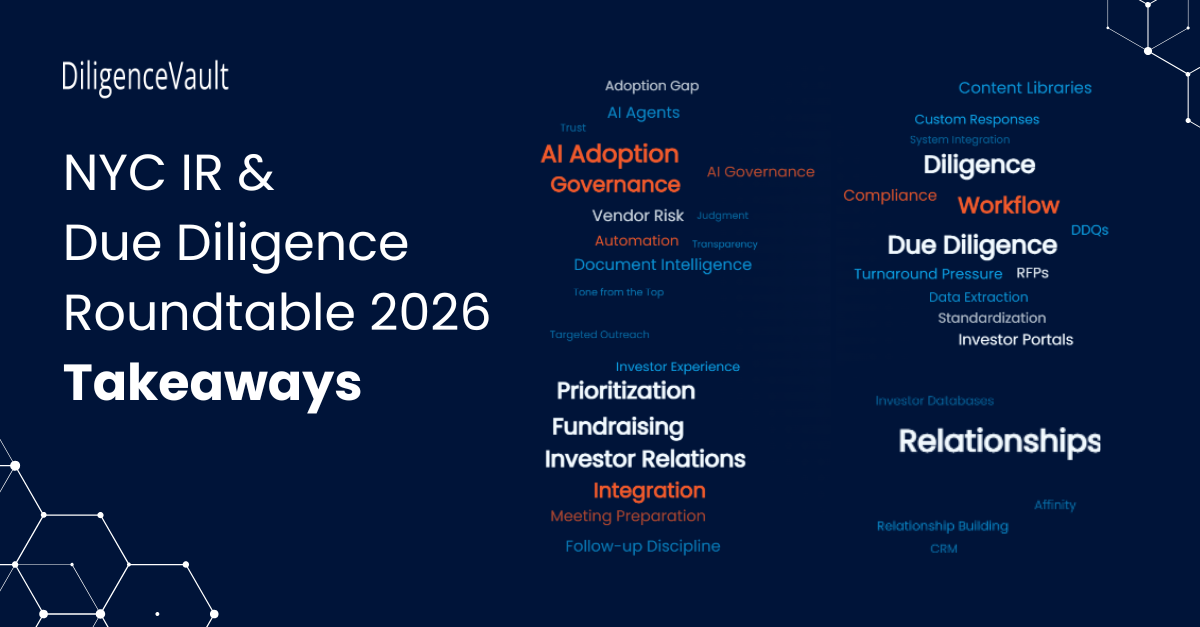
What the Room Was Talking About
Five themes ran consistently across the conversation. These are not new problems, but the pressure behind each of them has intensified.
1. Prioritization is the discipline that separates effective IR teams
The clearest organizing principle to emerge: focus on what brings revenue in the door. IR teams are stretched across multiple roles, and the most effective ones have made deliberate choices about where to concentrate effort.
- Investor requests are prioritized by length of relationship and size of mandate, the largest relationships receive the most attention.
- Smaller allocators tend to generate the most questions. The largest clients often outsource their deepest analytical work back to the manager.
- Some firms use access to standard diligence materials as a self-service first pass, allowing investors to get comfortable before IR bandwidth is committed.
- The principle that came up repeatedly: qualify before doing the work. This applies equally to RFPs, DDQs, and ad-hoc requests.
2. AI is being used but governance is lagging behind adoption
AI tools are showing up in IR workflows, but use cases remain largely at the edges of the work rather than the core.
- Active uses include meeting prep, investor research, drafting, and one-off document queries.
- Most teams have used AI to draw from existing Q&A libraries to help populate questionnaires. A smaller number have moved to AI autofill within their DDQ tools.
- The most commonly cited hesitation: concern about uploading confidential fund and LP documents into third-party AI tools, a governance question most firms have not fully resolved.
- When AI was first introduced at some firms, it created an unexpected problem: analysts submitted AI-generated content for senior review without adequate editing, which increased rather than reduced the burden on senior staff. AI accelerates content generation, which can result in more content when a simple email would have sufficed, and the review burden multiplies quickly.
- No LP has told any participant not to use AI, but the question of when and how to disclose AI usage in outputs is coming.
- AI adoption follows a pyramid: use is heaviest at the analyst level and decreases with seniority. At larger firms, this dynamic is amplified by compliance, legal, and IT constraints that limit which tools can be used, leaving less room for ad-hoc AI experimentation regardless of individual interest.
- Tone from the top matters. Where leadership has actively modeled and encouraged AI use, adoption is broader and more confident. Where it hasn’t, teams default to caution even when no formal policy exists.
- Teams that have successfully used AI for DDQs emphasize the importance of robust review and an honest understanding of AI’s failure modes.
- The energy in the room around AI was real. One participant spent four hours on a Sunday, across 56 iterations, with Claude building an integrated dashboard. Several firms are hiring AI interns to help build internal workflows. AI agents are an emerging area of interest, with teams beginning to explore how to build and deploy them within IR processes.
- Two internal communication approaches helping firms build understanding and buy-in around AI: a dedicated AI committee and a weekly newsletter sharing use cases and concrete wins.
3. The DDQ and RFP burden is not sustainable at its current trajectory
Questionnaire volume is increasing. Customization expectations are increasing. Turnaround expectations are tightening. All three at once.
- LPs increasingly expect custom responses and frequently do not accept standard ones. Allocators in Asia, in particular, send detailed requests and do not accept responses like “happy to discuss live” or “please refer to Q#.”
- Some investor DDQ portals are a significant time sink, with little consideration given to ease of use for managers or reusability of content.
- Excel-format DDQs with mandatory dropdown fields are universally frustrating.
- The ideal state described by the room: complete a response once and have it usable across Word, Excel, and bespoke portal formats without reformatting.
- IR teams own the response process but depend on subject matter experts for content and SMEs resist logging into new platforms, prefer email or printed formats, and are largely unwilling to change their workflows.
- ILPA and INREV standards were referenced as the direction standardization is heading.
4. The tech stack is fragmented, and integration is the real problem
IR teams are running more tools than ever, and most of them don’t talk to each other.
- CRMs, investor databases, DDQ tools, investor portals, fund administration platforms, and project management software all operate in silos.
- The challenge isn’t having too many tools. It’s that the data entered in one place doesn’t flow anywhere else.
- Practical knowledge of which tools serve which segments is itself a competitive advantage. Investor databases tend to have distinct strengths by market – Dakota for wealth management, Preqin for institutional, and the same holds for CRMs, where Affinity is favored for relationship tracking and Dynamo for configurability and flexibility.
- A consistent observation: even a superior tool won’t get adopted if it requires SMEs to abandon established, low-friction workflows.
- Job change alerts and real-time investor database accuracy were flagged as high-value capabilities that remain inconsistent across platforms.
5. In-person is back and the follow-up is where relationships are lost
The room was consistent: in-person meetings move relationships forward in ways that email cannot replicate. One participant shared a direct example: a targeted in-person outreach to a Texas public plan resulted in an allocation, a reminder that the channel still closes business in ways digital touch points don’t.
- Conferences are hit or miss, depending on attendee quality. Targeted, smaller-format events produce a better signal.
- Cold email outreach works better with a specific meeting request and a proposed time in the subject line. Getting a clear no is more valuable than getting no response.
- Meeting prep has become more sophisticated, and AI tools are being used to research counterparties and anticipate questions before walking in the room.
- Recording meetings would improve note-taking efficiency, but allocators tend to be less candid when recorded. Most teams are choosing to protect the quality and transparency of the conversation over the efficiency of the notes.
- Post-meeting follow-up cadence is where many relationships stall, the system for capturing what actually happened and acting on it remains inconsistent across most teams.
Questions the Room Left Open
These were raised but not resolved; they reflect where the industry is still forming a view.
- Should firms have a formal policy on which documents can be uploaded to AI tools, and who owns that decision?
- Is a content library still necessary if DDQs can simply be uploaded to an LLM and answered directly?
- As junior IR professionals stop performing repetitive tasks manually, how do they develop the judgment that repetition used to build?
- What happens when LPs are also using AI to analyze DDQ responses and benchmark managers, and neither side is fully transparent about it?
- How should firms think about vendor risk when core workflow tools are controlled by third parties whose pricing or terms can change?
Many of these themes are explored further in our latest article on the RFP & DDQ software landscape, where we break down how firms are approaching these challenges across tools, workflows, and AI adoption.
Read the full report here: The RFP & DDQ Software Landscape: Top Solutions Across 6 Categories
We hope this is a useful reflection of the conversation. We look forward to continuing it.
DiligenceVault