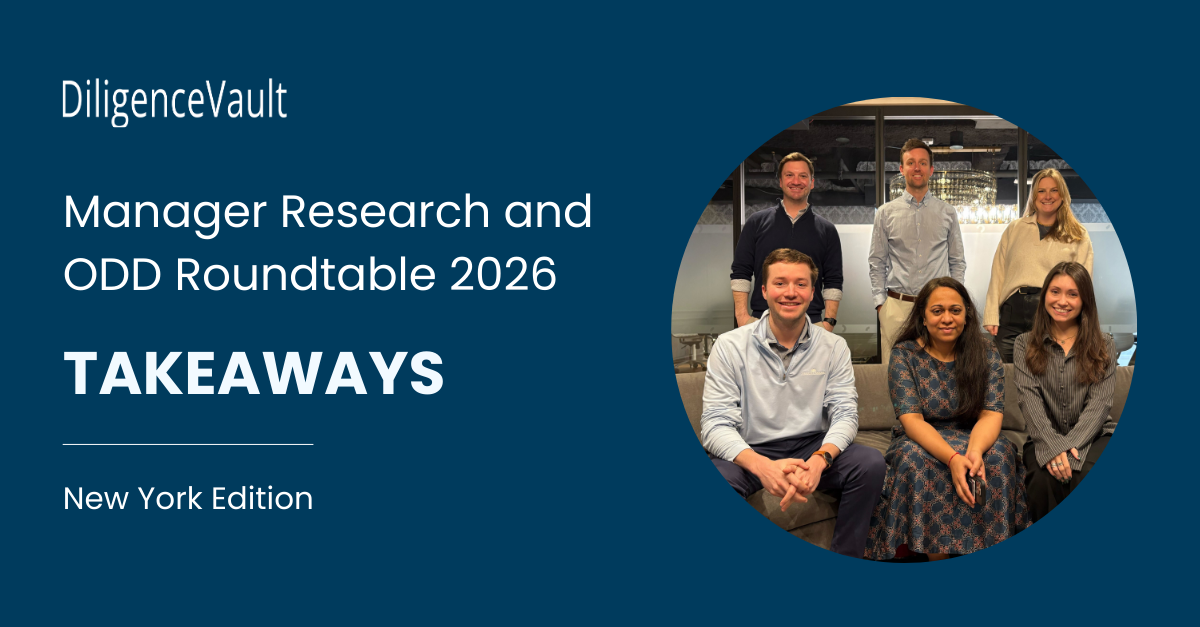
This summary captures the strategic and tactical insights from our recent manager research and Operational Due Diligence (ODD) roundtables.
These sessions brought together over 40 industry leaders, representing a diverse cross-section of wealth platforms, endowments, public pensions, bank platforms, OCIOs, consultants, and multi-manager firms, to dissect the evolving landscape of manager research and ODD, the integration of AI, and the shifting boundaries of fiduciary oversight.
The consensus reflects a “Trust but Verify 2.0” era: where technical operational oversight, investment risk validation, and advanced data analytics are no longer siloed, but deeply interconnected.
1. The AI Evolution: Governance, Productivity, and Headcount
The industry is moving from AI curiosity to a functional integration that impacts both oversight and organizational structure.
- Diligence Focus: Currently, AI diligence is centered on AI Governance (policies, data security, and internal vs. public cloud usage). The next phase of evolution will involve reviewing AI output for accuracy and evaluating how these tools provide a genuine competitive advantage in the investment process.
- The Headcount Paradox: When asked if AI is replacing jobs, most managers say “no.” However, allocators have observed that if operations staff headcount is declining, it is almost always due to automation via AI. This “knowledge decay” is a growing ODD concern, ensuring firms retain the manual skills to perform reconciliations if systems fail.
- Advanced Analysis: AI is already being deployed for Audited Financial Statement (AFS) analysis and spotting year-over-year financial statement changes that also highlight edge cases. Tools like DiligenceVault are being incorporated for extracting data from IMAs, PPMs, and LPAs.
2. The Transparency Trade-off: Hesitancy and Limited Success with AI Transcribers
There is significant reluctance among participants regarding the use of AI transcribers/recorders in meetings.
- Manager Concerns: Some managers explicitly prohibit these tools, citing concerns about maintaining confidentiality.
- Allocator Concerns: Allocators worry that the use of AI recording reduces the “candidness” of discussions.
- Success Rate: For the allocators who do record meetings, the success rate is only 50%.
- AI expense: The appropriate allocation of AI-related costs is currently under discussion, specifically, whether the expense associated with AI replacing analyst research should be borne by the fund or the management company.
3. Private Credit: Forensic Diligence & Asset Integrity
As capital continues to flood into Private Credit, the focus has shifted toward the forensic verification of structural protections.
- Collateral Integrity & FDD: A primary underrated risk is the double-pledging of collateral. This has made rigorous Financial Due Diligence (FDD) a mandatory step to verify that assets aren’t being leveraged across multiple credit facilities.
- Talent & Alignment: Diligence teams are scrutinizing the compensation structures of underwriting teams to ensure incentives are tied to long-term loan quality and recovery rates rather than pure deal volume.
- Regulatory Watch: Heightened oversight from global regulators, such as ASIC (Australia), is being viewed as a bellwether for tightening standards and increased reporting requirements in other major jurisdictions.
- Redemptions: Wealth platforms are seeing redemptions from their client base, driven by media coverage of Blue Owl, Cliffwater, Blackstone, and BlackRock private credit strategies.
4. Valuation: Friction, Conflict, and “Signal.”
Valuation is where Investment Research and ODD teams now collaborate most closely, on “process review” and active “mark validation.”
- The Independence Conflict: A major friction point for private markets is that the valuation agents are frequently paid by the manager, creating a perceived conflict of interest. Allocators are pushing for more conservative marks to reflect true market conditions.
- The “Mark” Conflict: It is common to find different managers holding the same asset with conflicting valuations due to subjective models or reporting lags (e.g., quarterly vs. monthly marks). Cross-referencing these valuations across different managers is becoming a more common practice for allocators.
- Personnel as a Signal: When research teams request fair value meetings, who the manager sends to the table is a critical indicator. Sending junior staff suggests the valuation function is viewed as a “back-office” afterthought.
- Back-Testing Requirement: Allocators are now demanding prior vintage back-testing to evaluate how a manager’s historical marks eventually compare to actual realization values at exit.
5. Human Capital & Underrated Risks
Traditional oversight is evolving into dynamic monitoring of business viability and “hidden” liquidity gaps.
- The Spin-out “Liquidity Gap”: For managers spinning out of multi-strat firms, anchor investors often secure managed account structures, while new fund LPs face significantly worse liquidity profiles for the same underlying strategy.
- SEC Findings as a Veto: A manager’s refusal to share an SEC exam findings letter is now widely considered an automatic red flag and potential veto.
- Management Company Transparency: Only 20–30% of GPs (primarily smaller/emerging firms) provide unaudited management company financials. Established firms rarely share them.
- The “Pass-Through” Drag: Aggressive expense pass-through structures have reached a point where gross and net performance can differ by as much as 60%.
- Hedge Fund Fee “Leakage”: A red flag is hedge funds charging performance fees on private asset sleeves before those gains are actually realized.
6. Background Checks
The roundtable discussions highlighted a significant shift in how Background Checks are conducted and integrated into the broader due diligence framework, as even today, some managers do not disclose legal issues during onsite diligence meetings.
Participants emphasized that the traditional “one-and-done” approach is being replaced by more rigorous, technology-enabled monitoring.
- “Always-On” Continuous Monitoring: There is a clear move away from conducting background checks only during initial diligence. Allocators are now implementing ongoing monitoring (typically every 2–3 years) to provide real-time alerts on new litigation, regulatory actions, or undisclosed issues.
- The Role of AI in Screening: While firms are increasingly using AI tools to scrape publications and legal databases, they noted a critical limitation: AI’s effectiveness is often hampered by paywalls and the limited accessibility of certain high-value publications, necessitating human verification.
- LP-Driven Requirements: Limited Partners (LPs) are becoming more prescriptive, with many now requiring managers to conduct full, independent background checks on their own employees as a condition of investment.
- Scoping & Subject Identification: AI is being leveraged early in the process to identify specific subjects (both entities and key personnel) that require deeper investigations, allowing ODD teams to be more strategic with their investigative budgets.
- Human Capital as a Dynamic Risk: Beyond criminal and credit checks, the focus has expanded to behavioral analysis and “bench depth.” The goal is to move beyond “checking the box” to ensure the long-term stability and integrity of the management team.
7. Cybersecurity, ESG, and Ongoing Review Trends
Cyber diligence has transitioned from a “check-the-box” exercise to a specialized technical review focusing on data privacy and infrastructure.
- Specialized Internal Review: Diligence teams are increasingly collaborating with internal Chief Technology Officers (CTOs) or Chief Information Security Officers (CISOs) to review IT-specific DDQs. For firms without internal experts, outsourcing this specialized review is becoming the standard.
- Managed Service Providers (MSPs): Increased scrutiny is now placed on the quality of MSPs. Since many managers outsource their IT, the varying security standards of these third-party providers have become a primary point of failure. Allocators may require a change in MSP if they see material flags.
- Regulatory Focus (Reg S-P): A critical area of review is compliance with Regulation S-P, specifically how firms protect non-public personal information (NPI) and their protocols for data breach notification.
- Headline Risk & PII: As managers distribute more heavily to the wealth/retail segment, they house vast amounts of Personally Identifiable Information (PII). This has created massive headline risk, yet many managers still do not maintain dedicated cyber insurance, a gap that will likely be an allocator focus. Manager feedback is that cyber insurance remains expensive, and may have carve-outs, making it less relevant.
- Insurance Benchmarking: Coverage limits for E&O and Fidelity insurance remain largely dictated by AUM levels.
- ESG/DEI Regional Divergence: There is a noticeable “clawback” of the “E” and “DEI” components in the US, whereas these remain top priorities for European and Japanese allocators.
Ratings are increasingly used to dictate the cadence of ongoing reviews, with higher-risk scores triggering more frequent onsite visits.
8. Reporting Trends & Client Transparency
The output of the research and ODD process is being used more strategically as a client relationship tool.
Report Sharing Tiers: Firms are navigating how to share diligence findings based on the client relationship:
- Full Disclosure: Entire reports are shared with clients who retain the firm specifically for research/diligence mandates (requiring extra care for global regulatory compliance).
- Redacted Versions: Shared with clients receiving diligence on the firm itself to protect proprietary or sensitive manager data.
- Summary Versions: Provided as a form of differentiation and value-add to improve broader client relationships.
- Digestible Memos: The trend is toward shorter, table-heavy, concise memos.
9. Crypto and Digital Assets Diligence
- Integrated Exposure: Many allocators now have exposure to crypto not as a standalone bet, but as a macro theme accessed through Venture Capital (VC) funds or specialized “sleeves” within diversified hedge funds
- Administrator Infrastructure Gap: A primary ODD concern is that many fund administrators still struggle with crypto-assets. This technical gap frequently leads to delayed Net Asset Values (NAVs) and audit completions, which are significant operational red flags.
- DeFi & “Vault” Risks: The emergence of smart-contract-based “vaults” introduces a new layer of due diligence. There is a specific risk where capital may be sub-advised to unknown third parties through these vaults without the investor’s knowledge or proper due diligence on the end-manager.
- Technical Audit Requirements: ODD teams are moving toward requiring Smart Contract Audit reports (such as SOC reports for Web3) to get comfortable with the underlying code and protocol security.
Looking Ahead: Resources & Talent
The industry continues to tool up in response to these complexities. Clients can access DiligenceVault’s AI DDQ for Asset Managers and AI DDQ for Vendors to help standardize the governance review process, as well as Reg S-P DDQ. For those looking to dive deeper into automation, you are invited to join our upcoming webinar on How to Build an AI Agent for Due Diligence.
Finally, the demand for specialized talent remains high. More than 3 firms are actively hiring within their ODD teams, signaling that despite the rise of AI, the “human in the loop” remains the ultimate backstop for fiduciary excellence.
Reference: Scott’s insurance framework